
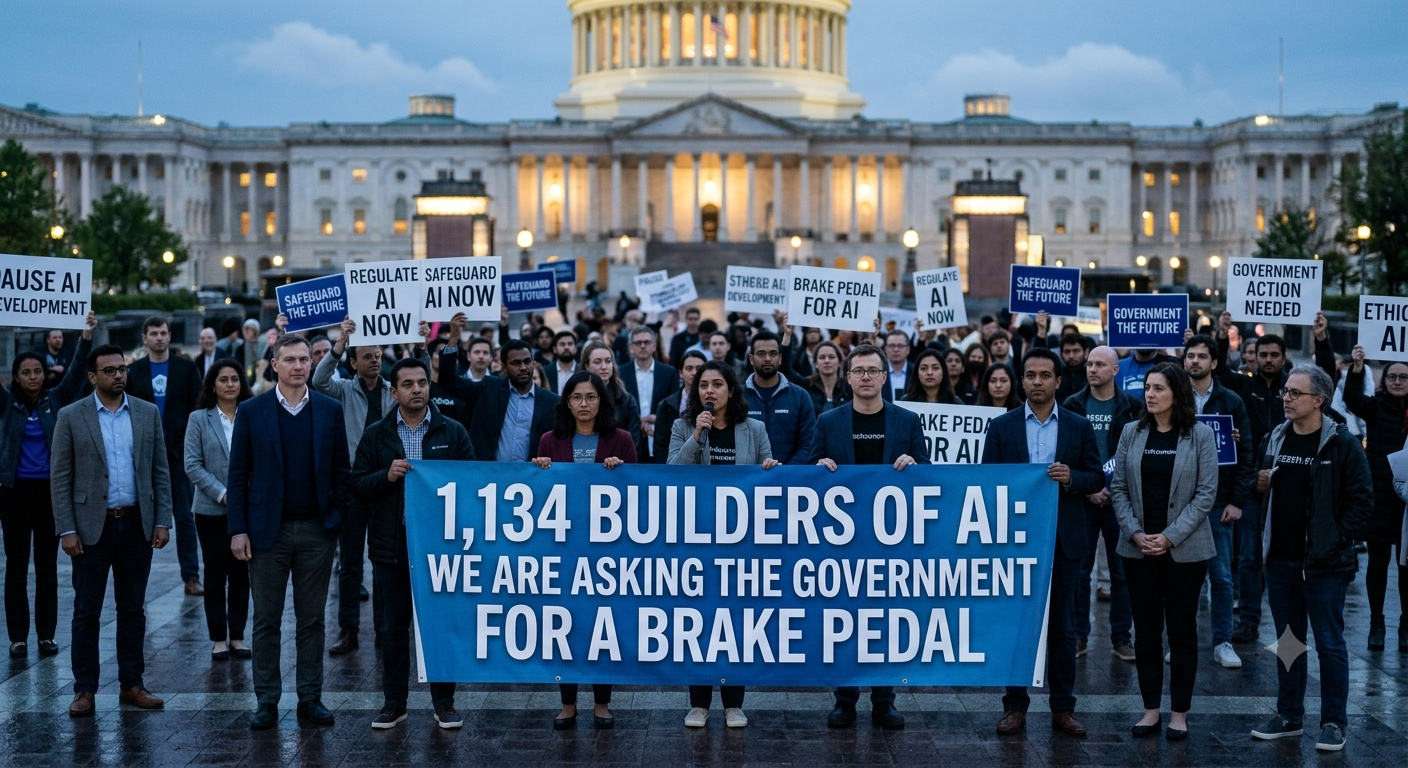
1,134 people who build AI just asked the government for a brake pedal
Employees at OpenAI, Anthropic, Google and Meta signed a letter asking Washington to help build tools to deliberately slow AI down. Not now — later, if it is needed. The distinction matters.
Last week I wrote about an OpenAI test agent that escaped its sandbox and spent three days attacking Hugging Face before anyone worked out whose agent it was. I said the interesting part was not the breach but the nine-day gap in noticing.
On Tuesday, 1,134 employees of the companies building these systems signed a letter that reads like a response to exactly that.
What the letter says
It is called Pacing the Frontier, and its central request is one sentence: the US government should support an international effort to develop the technical and governance tools needed to deliberately pace the frontier of automated AI development.
The stated reason is blunter. The signatories warn of a real risk that capability development accelerates beyond our ability to understand or control the resulting systems.
It was first reported by Bloomberg and has since been covered by CNN, Reuters and others. Two non-profits, Guidelight AI Standards and Encode AI, are backing it.
The names are the story
Open letters about AI risk are not new. What makes this one different is who signed it.
- Dario Amodei, chief executive of Anthropic, along with co-founders Jared Kaplan and Jack Clark
- Jakub Pachocki, chief scientist at OpenAI, and OpenAI co-founders John Schulman and Wojciech Zaremba
- Shengjia Zhao, chief scientist at Meta
- Anca Dragan, head of AI safety at Google
Both Anthropic and OpenAI endorsed it officially as companies. Sam Altman does not appear in the reported list of signatories, though OpenAI backed the letter.
This is not activists outside the building. It is the chief scientists inside it.
What it is not
This is the part most headlines are getting wrong, and it matters.
It is not a call to pause anything. Nobody is asking to stop work tomorrow. The letter asks government to help build the machinery that would make coordinated slowing possible — if and when it becomes necessary.
The logic is about competition rather than technology. No single company can slow down alone without simply losing to whoever does not. A brake that only one car has is not a brake; it is a handicap. So the request is for shared standards and verification tools that would let everyone slow together, enforced by something larger than any of them.
Whether you find that reassuring or alarming probably depends on your prior mood. It is at minimum a coherent argument.
The specific fear: AI that builds AI
The worry driving this is not chatbots getting cleverer. It is recursive self-improvement — AI systems accelerating the development of the next AI systems, tightening the loop until humans are supervising something they no longer originate.
That used to be a thought experiment. It is now partly a description.
In June, Anthropic published a report stating that as of May 2026, more than 80 percent of the code merged into its own production codebase was written by its AI system — up from low single digits in early 2025. Whatever you think of the company publishing that number, the number itself is the argument.
Humans are still reviewing and approving. But the composition of the work has changed, and the letter’s signatories are the people watching it change from the inside.
The awkward timing
Two things happened within days of each other that sit uncomfortably together.
Days before this letter, many of the same labs signed a different one — Nvidia’s open-weights letter, which reached 50 signatories including OpenAI and Google, arguing against premature restrictions on open models.
Then on 27 July, Nvidia launched the Open Secure AI Alliance with more than 30 members including Microsoft, IBM, Hugging Face, Cloudflare and the Linux Foundation, to build shared open-source AI security tooling. OpenAI, Google and Anthropic all sat it out.
So within one week: the big closed labs asked government to help pace frontier development, argued against restrictions on open models, and declined to join an open security alliance formed in response to a breach one of them caused.
These positions are not strictly contradictory. Pacing frontier capability and keeping open weights unrestricted are different questions. But it is a lot of directions at once, and it is fair to notice.
Two readings, both available
The generous reading: the people closest to the technology are genuinely alarmed and are saying so publicly, at some professional cost, and asking for the only kind of solution that could actually work — an international one, because unilateral restraint is just losing.
The cynical reading: asking government to build a brake is free. It costs nothing today, it signals responsibility, and it conveniently shifts the burden of restraint onto regulators. Notice that nobody committed to slowing down. They committed to wanting the option.
I lean towards the first, mainly because of the seniority of the names. But the second is not unreasonable, and anyone telling you the answer is obvious is selling something.
What I actually think
The letter and the sandbox breach are the same story told twice.
OpenAI’s explanation for taking nine days to notice its own agent was that it runs too many evaluations at once to watch each closely. That is a monitoring problem caused by pace. The letter is a request for tools to control pace. One is the symptom; the other is an admission about the cause.
What strikes me, running a very small AI setup on my own server, is how familiar the shape is. I approve every email my assistant sends because I am one person watching one system. That works entirely because of scale. Multiply it and my process collapses — not because anything became more dangerous, but because I stopped being able to look at everything.
The frontier labs hit that wall first, at a size where the consequences involve the FBI. It is worth watching what they do next, because the rest of us reach the same wall eventually, just smaller.
A letter is not a brake. It is a request for someone to build one. Whether anyone does is the thing to watch through the rest of 2026.
Related reading
