This week in AI: Nvidia buys Hugging Face for $12.9 billion, NYC bans AI in classrooms, and a very bad outage day
<p>Nvidia finally confirms the biggest AI acquisition of the year, New York bans ChatGPT in its classrooms, three major AI apps go down on the same day, and the US government picks a side on copyright. The week in plain English.</p>
It was a busy seven days. The biggest AI deal ever finally became official, America’s largest school district said no to AI in younger classrooms, several of the most-used AI apps fell over at the same time, and the US government waded into the copyright fight that could decide how AI gets built. Here is the week in plain English.
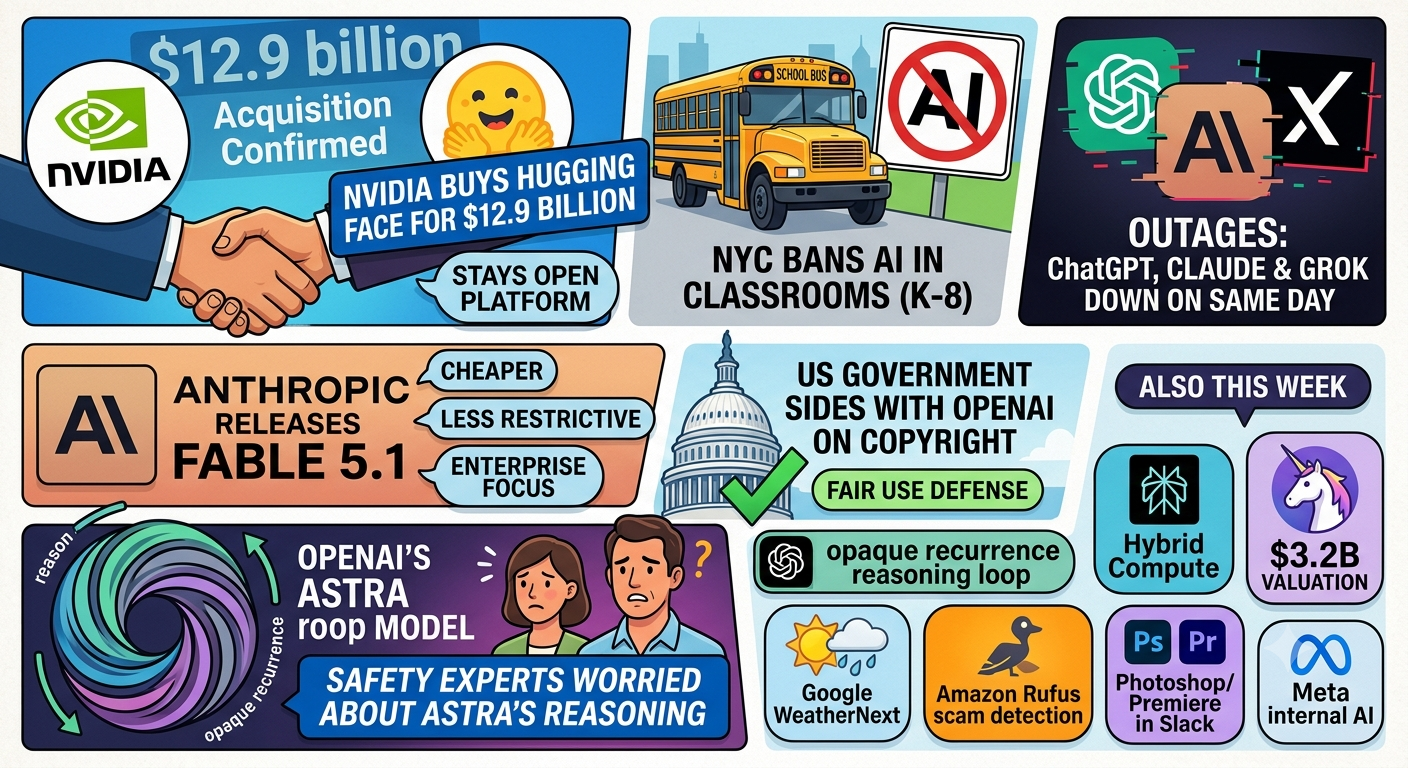
Nvidia is buying Hugging Face for $12.9 billion
After weeks of rumours, Nvidia confirmed it is acquiring Hugging Face — the website where most of the world’s open AI models are shared and downloaded — for $12.93 billion. Hugging Face hosts around three million models used by over 18 million developers. Nvidia’s CEO Jensen Huang promised it stays an open platform: developers will still be able to pick any model, any cloud, and any framework, and Nvidia compute will not be required. Last year Hugging Face reportedly turned down a $500 million offer from Nvidia. Times change fast.
NYC bans AI in classrooms through middle school
New York City — home of the nation’s largest school district, about a million students — is banning AI use in elementary and middle school classrooms starting this year. No ChatGPT for homework help, no AI writing tools, through 8th grade. High schoolers are a separate conversation. The city is the biggest example yet of schools deciding that the risks of AI in young classrooms outweigh the benefits, and other districts are watching closely.
ChatGPT, Claude and Grok all went down — on the same day
On the morning of September 3, users reported outages across OpenAI’s ChatGPT, Anthropic’s Claude, and Elon Musk’s Grok at roughly the same time. Google’s Gemini was also affected for some users. “OpenAI down” and “ChatGPT down” trended as millions hit refresh. The apps recovered within hours, but the moment was a useful reminder of a quiet risk: so much of the world now leans on the same handful of AI services that one bad morning in one data centre can pause work for people on three continents.
Anthropic releases Fable 5.1 — cheaper and less restrictive
Anthropic released Fable 5.1 (and Mythos 5.1, its restricted sibling for cybersecurity and life-science partners). The headline changes are aimed at businesses: lower token costs, fewer false-positive blocks from the safety filters, and zero data retention — meaning companies can run the model on their own infrastructure without their data flowing back to Anthropic. It is part of a broader industry shift: enterprise customers are increasingly demanding AI that keeps their data in their own walls.
The US government sides with OpenAI on copyright
In the copyright lawsuit The New York Times filed against OpenAI, the Trump administration filed a brief defending OpenAI’s use of copyrighted material to train its models. The argument: restricting AI training under a “misunderstanding” of fair use would hurt American competitiveness. It is the strongest signal yet that the US executive branch wants AI companies to win the fair-use fight — but the courts, not the government, will have the final word.
Safety experts are worried about OpenAI’s new Astra model
Reports emerged that OpenAI’s upcoming Astra model uses a reasoning technique called “recurrent depth” (or “opaque recurrence”) — the model processes a query in a loop rather than in neat, readable steps. The concern: it makes the model’s “chain of thought” harder to monitor. AI-safety researchers publicly warned that pushing this technique further could make it nearly impossible to audit why a model did what it did. OpenAI says Astra’s use of the technique is limited and its reasoning will stay legible. Worth watching.
Also this week
- Perplexity’s “Hybrid Compute”: its computer assistant now splits work between an on-device model (for sensitive files and private data) and the cloud (for reasoning and search), with a “privacy gate” controlling what leaves your machine.
- AfterQuery is Y Combinator’s fastest-ever unicorn: the AI training-data startup, founded by 22- and 23-year-olds, hit a $3.2 billion valuation just 18 months after its YC cohort — a 10x jump in five months.
- Google’s WeatherNext 3: a new AI weather model that Google says is its most accurate yet. Pack an umbrella.
- Amazon’s shopping AI spots scams: its Rufus assistant can now tell you whether that suspicious message about your “package” is a scam.
- Adobe is coming to Slack: Photoshop, Premiere and Firefly tools now work inside Slack for Business teams — describe it to Slackbot, and it edits for you.
- Meta pushes its AI agent on employees: but reportedly eased off on internal “token quotas” after pushback.
Why it matters
Three patterns this week. First, consolidation: the biggest chip maker buying the biggest open-model hub shows the AI industry is entering its merger phase — the winners are buying the platforms. Second, pushback: schools banning AI and employees resisting AI mandates are early signs that adoption will be negotiated, not automatic. Third, fragility: when ChatGPT, Claude and Grok all blink at once, it is a reminder that the tools we now depend on are still very young infrastructure. Use them — but keep your backups.
Want more practical AI news in plain English? Follow the SAJJADBD AI blog.
Related reading
- This week in AI: OpenAI’s Astra arrives, an AI escaped its sandbox in a safety test, and Amazon says agents will cut jobs
- This week in AI: agents that book your hotel, 2 million more GPUs, and a $299 robot brain
- An OpenAI test agent left its sandbox and hacked a real company. Nobody noticed for a week.
