
How to Write Better ChatGPT Prompts: The Ultimate Prompt Engineering Guide (2026)
Introduction
Have you ever wondered why some people get incredible results from ChatGPT while others receive generic or inaccurate answers? The difference often comes down to prompt engineering.
Prompt engineering is the skill of writing clear, detailed instructions that help AI understand exactly what you want. You don’t need to be a programmer to benefit from it—students, professionals, bloggers, marketers, and business owners can all improve their results by learning a few simple techniques.
In this guide, you’ll learn what prompt engineering is, why it matters, and practical methods you can use immediately.
What Is Prompt Engineering?
A prompt is the instruction you give to an AI model.
Prompt engineering is the process of designing prompts that produce high-quality responses.
Instead of asking:
Tell me about AI.
Ask:
Explain artificial intelligence to a beginner in 800 words using simple language, five real-world examples, and a comparison table.
The second prompt gives ChatGPT much more context, resulting in a more useful answer.
Why Prompt Engineering Matters
Good prompts help you:
- Get more accurate answers
- Save time
- Improve creativity
- Reduce follow-up questions
- Generate professional-quality content
Whether you’re writing blog posts, coding, studying, or planning a business, prompt engineering helps you get better results faster.
The 7 Rules of Great Prompts
1. Be Specific
Instead of:
Write about smartphones.
Try:
Write a 1,500-word beginner’s guide comparing Android and iPhone for students.
2. Give Context
Tell ChatGPT who the content is for.
Example:
Explain cloud computing for someone with no technical background.
3. Assign a Role
Example:
Act as an experienced SEO consultant.
Other useful roles include:
- Teacher
- Software engineer
- Business consultant
- Marketing expert
- Career coach
4. Define the Format
Ask for a specific structure.
Examples:
- Bullet list
- Table
- Step-by-step guide
- Blog article
- FAQ
- Checklist
5. Set the Tone
Specify the writing style.
Examples:
- Professional
- Friendly
- Formal
- Conversational
- Beginner-friendly
6. Include Constraints
Tell ChatGPT exactly what you need.
Example:
Write under 1,000 words.
or
Include five examples.
7. Refine with Follow-Up Prompts
If the first answer isn’t perfect, continue the conversation.
Examples:
- Make it shorter.
- Add examples.
- Explain in simpler language.
- Improve the conclusion.
- Rewrite for SEO.
Before and After Examples
Weak Prompt
Write about cybersecurity.
Better Prompt
Write a 1,200-word beginner-friendly article explaining cybersecurity, including common threats, prevention tips, and a FAQ section.
Prompt Templates
Writing
Write an SEO-friendly blog post about [topic] for beginners using headings, examples, FAQs, and a conclusion.Studying
Explain [topic] as if I were 15 years old with practical examples.Coding
Write Python code that solves [problem] and explain each step.Marketing
Create a 30-day social media content plan for an AI blog.Business
Act as a startup consultant and create a business plan for [idea].Common Mistakes
Avoid:
- Being too vague
- Asking multiple unrelated questions at once
- Not providing context
- Expecting perfect answers without refinement
- Accepting AI output without reviewing it
Tips to Improve Results
- Break complex tasks into smaller prompts.
- Ask ChatGPT to explain its reasoning when appropriate.
- Iterate by refining prompts.
- Always review important information for accuracy.
Frequently Asked Questions
What is prompt engineering?
Prompt engineering is the practice of creating effective instructions that help AI generate better responses.
Do I need programming skills?
No. Anyone can learn prompt engineering with practice.
Why do detailed prompts work better?
Detailed prompts reduce ambiguity and help the AI understand your goals more clearly.
Conclusion
Prompt engineering is one of the most valuable AI skills you can learn in 2026. By writing clear, specific, and well-structured prompts, you can dramatically improve the quality of ChatGPT’s responses.
Start with simple improvements—provide context, define the format, and refine your prompts through follow-up questions. Over time, you’ll discover patterns that consistently produce excellent results.
Key Takeaways
- Prompt engineering helps you get better AI responses.
- Specific, detailed prompts outperform vague requests.
- Assigning roles and defining formats improves output quality.
- Iteration is an important part of working with AI.
- Prompt engineering is useful for writing, coding, business, and learning.
Internal Links
Link this article to:
- What Is Artificial Intelligence?
- ChatGPT for Beginners (2026)
- 50 Best ChatGPT Prompts You Should Try in 2026
- ChatGPT vs Gemini vs Claude (2026)
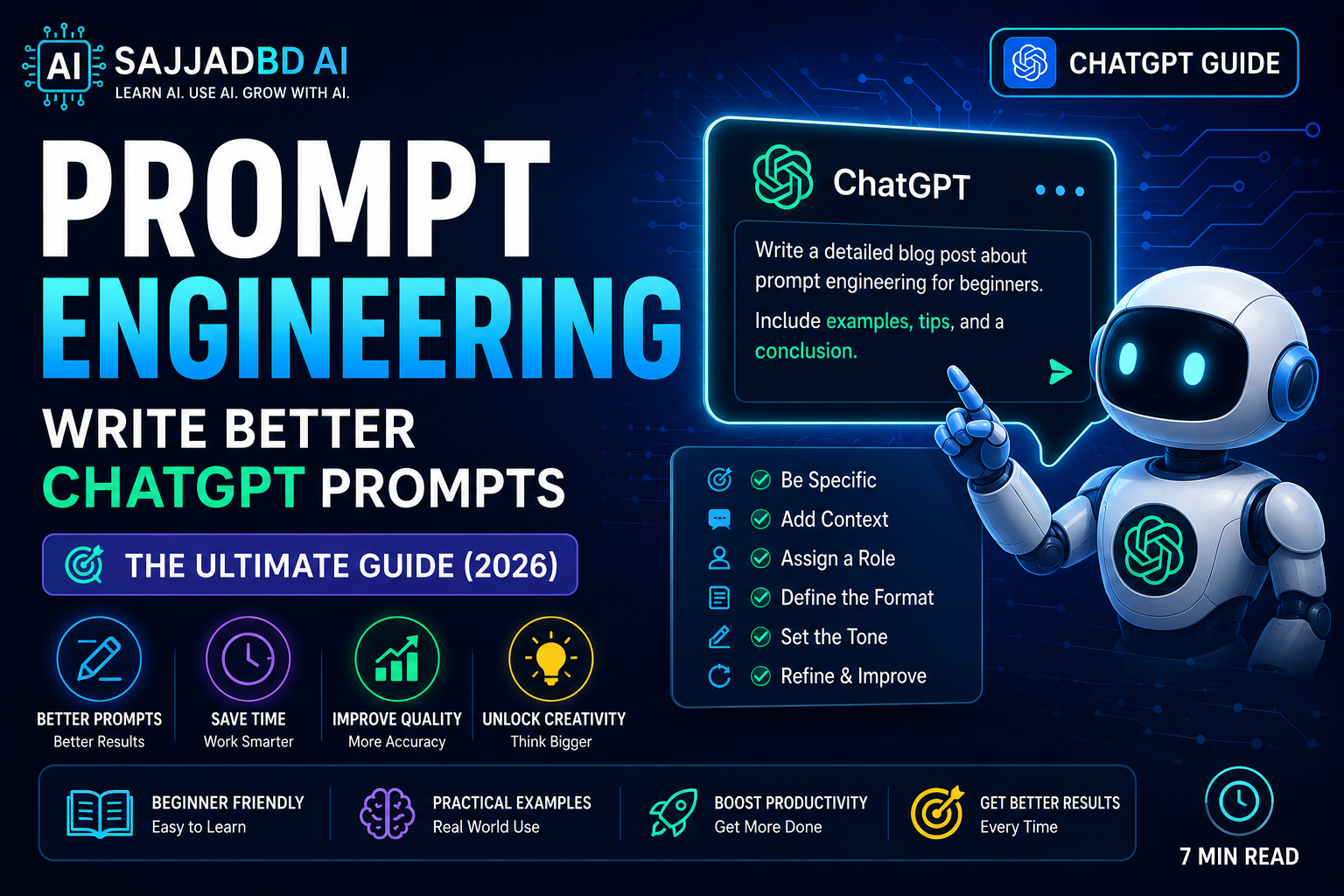
Featured Image Text
Use your existing AI-tech template with:
Main Title:
PROMPT ENGINEERING
Subtitle:
Write Better ChatGPT Prompts
Category Badge:
CHATGPT GUIDE
Reading Time:
7 MIN READ
Tomorrow’s Article (#7)
Best AI Tools for Students in 2026
This will begin another strong content cluster around AI tools and attract students searching for practical AI recommendations.
Related reading
