ChatGPT Wallet Lets AI Agents Pay For You
OpenAI's ChatGPT Wallet lets AI agents check out for you. What it means for expense records, spend limits and small-business books.
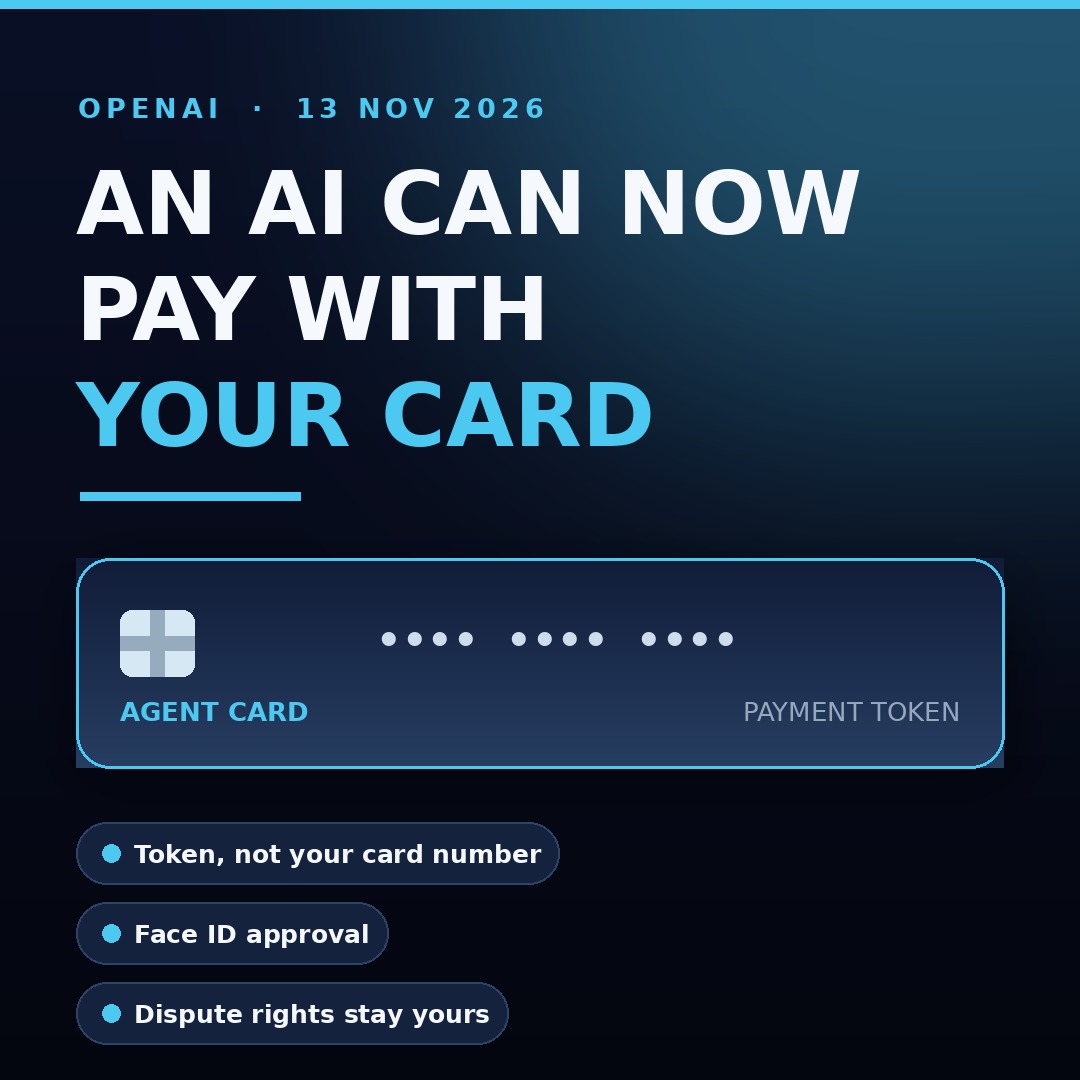
On Friday 13 November 2026, OpenAI turned on something that should make every accountant sit up: ChatGPT can now pay for things.
The new feature is called ChatGPT Wallet. In OpenAI’s own words, its agents — the little helpers inside ChatGPT, called “dots” — can now help you decide what to buy and then complete the purchase on your behalf. Not a demo. A real checkout, with a real card.
Right now it is very limited: a small number of US ChatGPT Pro subscribers, aged 18 and over, with a US-issued Visa, Mastercard or American Express. So no, you cannot switch it on from Bahrain today. But the mechanics tell you exactly where this is going — and that matters for our work.
How the money actually moves
This part decides whether your books stay clean.
You add an eligible card to the ChatGPT Wallet once. When a dot is ready to buy something, it charges that card using a payment token — a stand-in number that replaces your real card details. OpenAI says the token is not shared with the dot and not shared with the merchant. Your actual card number never travels.
Before the charge happens, you are shown the items, the total, and which card will be used. Then you approve with a security check — Face ID or a fingerprint — and that approval creates a record of the transaction. The merchant then automatically receives what it needs to ship the order, like your address and contact details, without you typing anything.
Two points buried in the launch noise, both good news for us:
- You still earn your normal card rewards on these purchases.
- Your normal card protections still apply, including the right to dispute a transaction.
OpenAI also says spending limits are coming — the ability to set a cap, or restrict purchases by category or by time period, so an agent can buy within rules you pre-approve. That is the feature I am actually waiting for. A limit is a control. Without one, you are not delegating a purchase, you are delegating your judgement.
Why this is not just a shopping story
Look at the numbers around it. DoorDash and Uber have both reported low volumes of orders placed by AI agents, so the demand is not proven yet. But Meta’s Muse has passed 10 million users, and AI-assisted shopping is one of its top activities. Instinct and other personal agents already buy on a user’s behalf. Amazon is the loudest holdout, blocking agents from its site to push people to its own assistant instead, and OpenAI has published a Commerce Partner Playbook to get retailers on board.
Read that combination carefully. The payment rail is being built in public, retailer by retailer, and the agent sits between buyer and merchant. When that settles, a share of small purchases will arrive in your accounts with no human having pressed a button.
What I am changing in my own routine
I have spent years closing books where every expense had a person behind it. That assumption is now negotiable, so here is what I would do rather than wait for the feature to reach the Gulf.
One, keep agent spending on its own card. Never the card that carries your main credit limit or your supplier standing. If a dot goes wrong, you want a small, capped, boring card to be the one that fails.
Two, demand the approval record. The Face ID confirmation is a timestamped authorisation. Treat it like a signature and keep it with the invoice. If the bank ever asks “who approved this”, that record is your answer.
Three, code the expense the day it lands. Agent purchases are small and frequent, which is exactly the profile that slips past a monthly review. A BHD 12 item that nobody codes is not a rounding error, it is an unexplained balance in three months’ time.
Four, write the rule before the limit exists. Decide now what an agent may buy without asking: office supplies, a subscription renewal, a courier fee. Everything else waits for a human. Put it in writing, because when the spending-limit feature arrives you will simply be copying your own policy into a settings screen.
I am not worried that AI will spend my money badly. I am worried that it will spend it neatly — with a clean receipt, a correct total, and no story attached. Reconciling that is our job.
Bottom line: ChatGPT Wallet is live in the US only, on Pro plans, and it uses payment tokens with a Face ID approval and normal card protections. The controls are thin today and the spending limits are promised. Set your own policy first, and the tool becomes useful instead of frightening.