Claude Fable 5.2: Cheaper AI, Real Accounting Work
Anthropic's Claude Fable 5.2 and Mythos 5.2 landed on 9 November 2026 with lower prices and published cost-per-task curves. What a finance team should take from it.
On 9 November 2026 Anthropic released two new models, Claude Fable 5.2 and Claude Mythos 5.2. Most of the coverage went straight to the benchmark table: the operating system it built from an empty folder, the black-hole physics problems, the Fermat proof in 30 hours. Impressive, but not my problem.
What caught my attention as a chief accountant was a different section of the announcement — the one about cost per task. That is the only number that ends up in my department’s budget.
The price, in plain terms
Fable 5.2 and Mythos 5.2 are the same underlying model. Fable is the version with strong cybersecurity and biology safeguards, so anyone can use it. Mythos is the same brain with fewer guardrails, released only to organisations approved through Anthropic’s verification programmes.
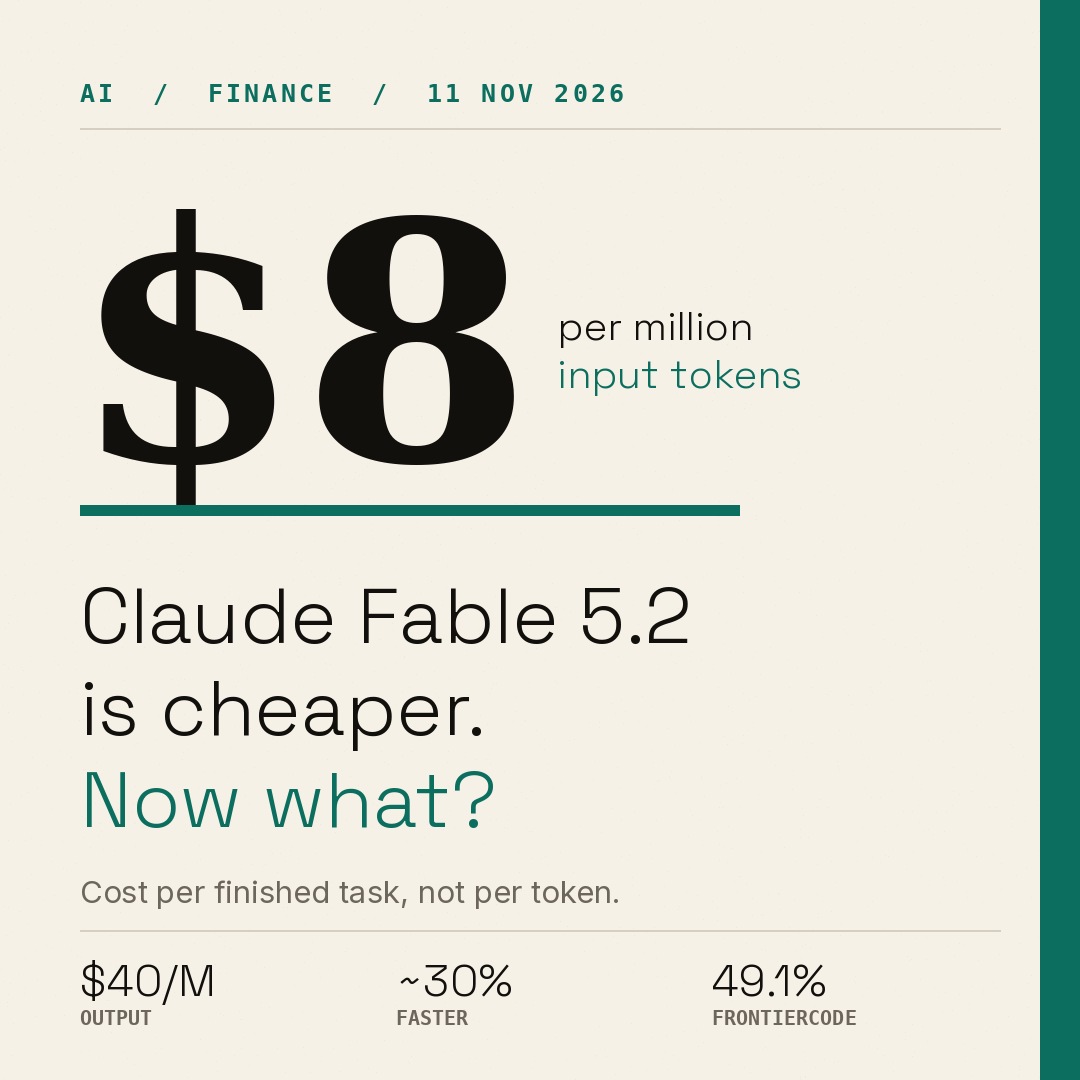
Both are priced at $8 per million input tokens and $40 per million output tokens. There is an optional fast mode at $16 and $80 that generates up to 2.5 times faster. Anthropic also says outputs come roughly 30 percent faster than the previous versions.
Here is how that lands in a real month. A month-end variance report — the data pasted in, plus my questions — might be 25,000 input tokens and 6,000 output tokens. Input: 25,000 × $8 ÷ 1,000,000 = $0.20. Output: 6,000 × $40 ÷ 1,000,000 = $0.24. So about $0.44 per report. Forty of those in a closing month is $17.60. That is not a budget line. That is a rounding error.
Why cost per task beats cost per token
The important detail is not the headline rate. It is that Anthropic published accuracy-versus-cost curves this time, and the story on those curves is effort levels.
At High effort, Fable 5.2 scored about the same as Claude Opus 5.5 at its maximum effort on their agentic coding test — 45.3 percent against 45.5 percent — for roughly half the cost per task. At extra-high effort it reached 49.1 percent, the best they have measured. On the chart-reading test, at Medium effort it scored 66.4 percent, ahead of Opus 5.5 running flat out at 64.4 percent, for less than one tenth of the cost per task.
Read that again, because it is the whole lesson: a cheaper model pushed harder beat an expensive model pushed to its limit — and did it for less.
That is exactly the mistake I made when I first started using these tools. I would paste a full trial balance into the most capable model available, ask a vague question, and accept whatever came back. The expensive part was never the tokens. It was the rework.
Where I would actually use it
Not for posting entries. Nothing here changes that a human signs the journal. But in the work around the ledger, the gap has narrowed enough to matter:
- Reading supplier statements. The chart-reading score matters more to me than any coding benchmark. Half of reconciliation is reading a PDF statement full of columns and spotting the invoice that is not in my ledger.
- Variance commentary. Feeding a comparison sheet and asking for the three variances worth explaining first — with the calculation shown, not asserted.
- Excel and VBA. A stubborn macro or a formula that breaks on blank cells is now a two-minute conversation instead of an afternoon.
- Drafting the boring letters. Payment reminders and SOA covering notes, once I have decided the tone.
What I still check by hand
Every total. Every time. The model is fluent about numbers, and fluency is not accuracy. My rule has not changed: if the tool produces a figure, I reproduce it in Excel before it goes anywhere near a customer or a ledger. On the cybersecurity test the model found more vulnerabilities than earlier versions — good for a security team, but it tells me nothing about whether my aged-receivables total is right.
I also keep the effort dial in mind. A quick classification task does not need maximum reasoning, and paying for maximum reasoning on a simple job is how this technology gets a reputation for being expensive.
Availability
Fable 5.2 is available now on all three major clouds — AWS, Google Cloud and Microsoft Azure — and through the Claude API as claude-fable-5-2. Mythos access is by application only.
The tool got cheaper and better in the same week. That is not the interesting part. The interesting part is that the question changed. It used to be “can the model do this job at all?” Now it is “at what effort level, and what does one finished task cost me?” That is a question an accountant is well equipped to answer.
Source: Anthropic, “Introducing Claude Fable 5.2 and Claude Mythos 5.2”, 9 November 2026. Pricing and benchmark figures as published by Anthropic.