Gemini 4 Carbon Tops the Charts, But You Can’t Use It Yet
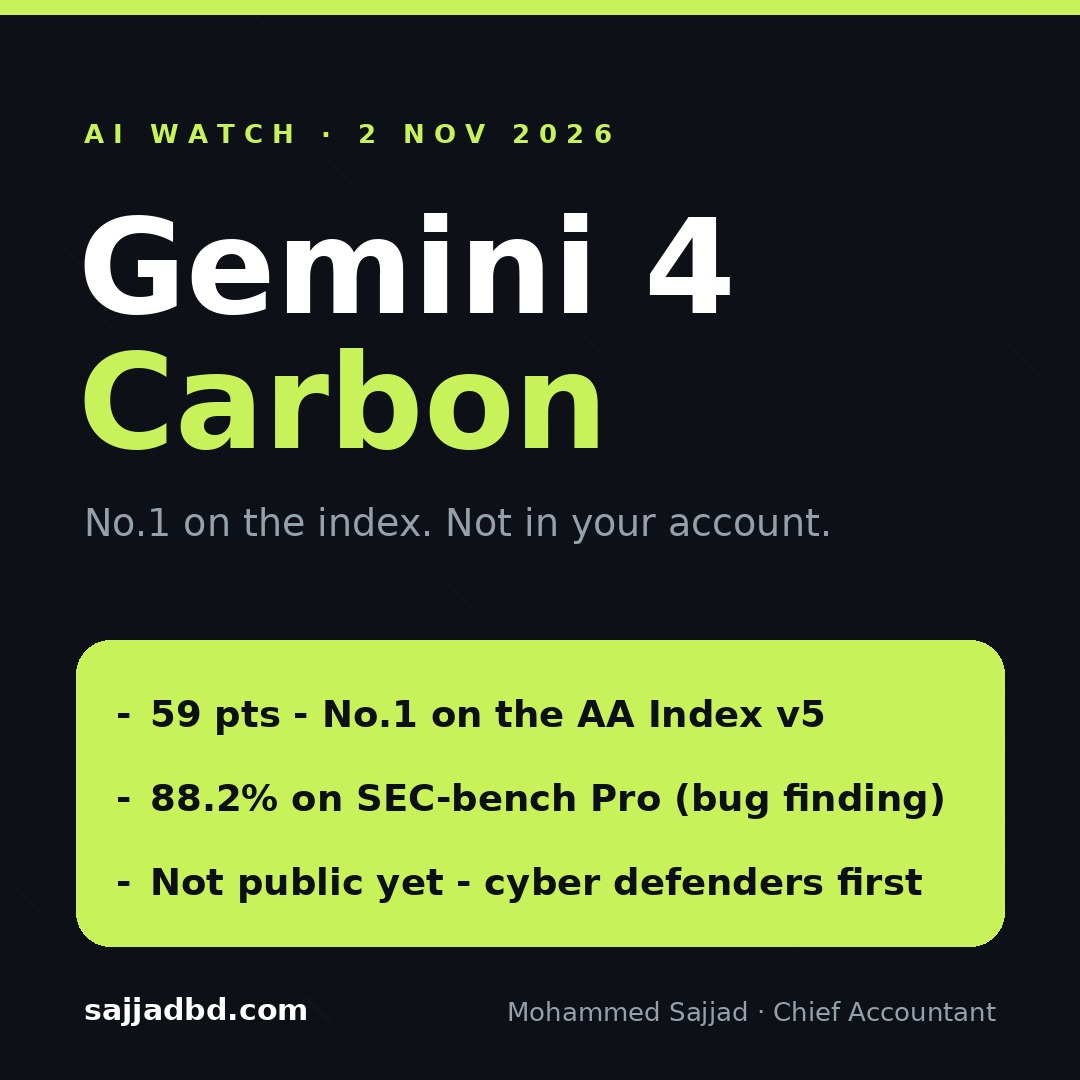
Google announced Gemini 4 Carbon on 28 October 2026, and on paper it is the strongest model in the world right now. It also happens to be a model almost nobody can log into. Both of those things matter to me, because I run a finance department — not a research lab — and I decide where our AI spend goes.
Here is what happened, what the numbers actually say, and what I am doing about it this week.
What Google actually released
Carbon is the follow-up to Gemini 4 Argon, which launched two weeks earlier. Google DeepMind’s Koray Kavukcuoglu described it as their strongest model, with state-of-the-art cybersecurity and long-horizon capabilities. It went straight to number one on the updated Artificial Analysis Intelligence Index v5 with a score of 59.
The cyber numbers are the headline: 88.2% on SEC-bench Pro for finding vulnerabilities, 54.8% on ExploitGym for exploitation, and 71.0% on CWE-bench for patching. On WebDev Arena it jumped 89 Elo points to fourth place at 1768. Context window is 1 million tokens, and it takes text, image, video and speech as input with text output.
Then there is the awkward part. Carbon is not publicly available. Google is releasing it to a subset of cyber defenders first, then phasing access to trusted partners through its Fairwind Program, while it gathers feedback and tightens guardrails. It is also going through the US government’s voluntary pre-release testing process.
The number I care about more than the ranking
Rankings make good headlines. Cost per task pays my bills. Artificial Analysis measured Gemini 4 Carbon at $7.76 per Intelligence Index task, about 23% cheaper than Claude Opus 5.5 at $10.04, though roughly 1.2 times the cost of GPT-6 Astra at $6.25. It burns 123,000 output tokens per task — 29% fewer than Opus 5.5.
Pricing follows Argon: $2 per million input tokens and $10 per million output tokens as an introductory rate, against $4 and $20 standard. Cached input is 95% off, which for accounting work is the detail that actually changes the maths. Most of my prompts re-send the same ledger context, chart of accounts and month-end checklist. Cache pricing is where the saving lives, not in the headline rate.
One caution flag. Carbon leads on AA-Omniscience with 54, but its hallucination rate rose from 4% on Argon to 11%. Still the second lowest measured, still a jump. For a model that names accounts and posts journals, an 11% fabrication rate is not a footnote — it is the reason every output still gets checked by a human.
Why the honest answer is “wait”
My instinct with every new release is to test it on real work the same week. I cannot do that here, and I am not going to pretend otherwise by quoting benchmarks as if they were my own results.
What I am doing instead:
- Not migrating anything. Our workflows run on models we can actually call today. Switching plans around a model with no public endpoint is how you end up with a broken month-end close.
- Watching the discount clock. The 50% launch rate has no confirmed end date. If Carbon opens up to business accounts, budgets need a number ready, not a scramble.
- Testing the gap, not the hype. Argon is available and still strong. If Argon cannot handle a task, Carbon’s improvements probably will not rescue the workflow either — the problem is usually my instructions, not the model.
What this means for accountants specifically
The cyber angle sounds far from accounts payable, and it is not. The capability being demonstrated is a model that reads a large codebase or system, finds a weakness, and fixes it. Swap “codebase” for “ERP configuration” or “spreadsheet model with forty linked tabs”, and you can see where this lands in two years: an assistant that audits the logic of your ledger, not just the totals.
That is genuinely useful. It is also the reason access is restricted. A model that good at finding weaknesses is equally good at finding them in systems that were never designed to be attacked.
So my honest read: Gemini 4 Carbon is a real step forward and a genuine number one. It is also, for now, a press release with a benchmark attached. I will keep using what I can log into, keep checking every number that comes out of it, and revisit when Google opens the door.
If you are deciding where to spend your AI budget this quarter, the boring answer still wins: pick the model you can use today, measure what it saves you, and let the leaderboard move without you.