Mistral Large 4 Goes Open: Why Accountants Care
Mistral released the weights of its 1-trillion-parameter Large 4 model on 29 October 2026. A chief accountant's plain take on lower cost per task, data control and what to ignore.
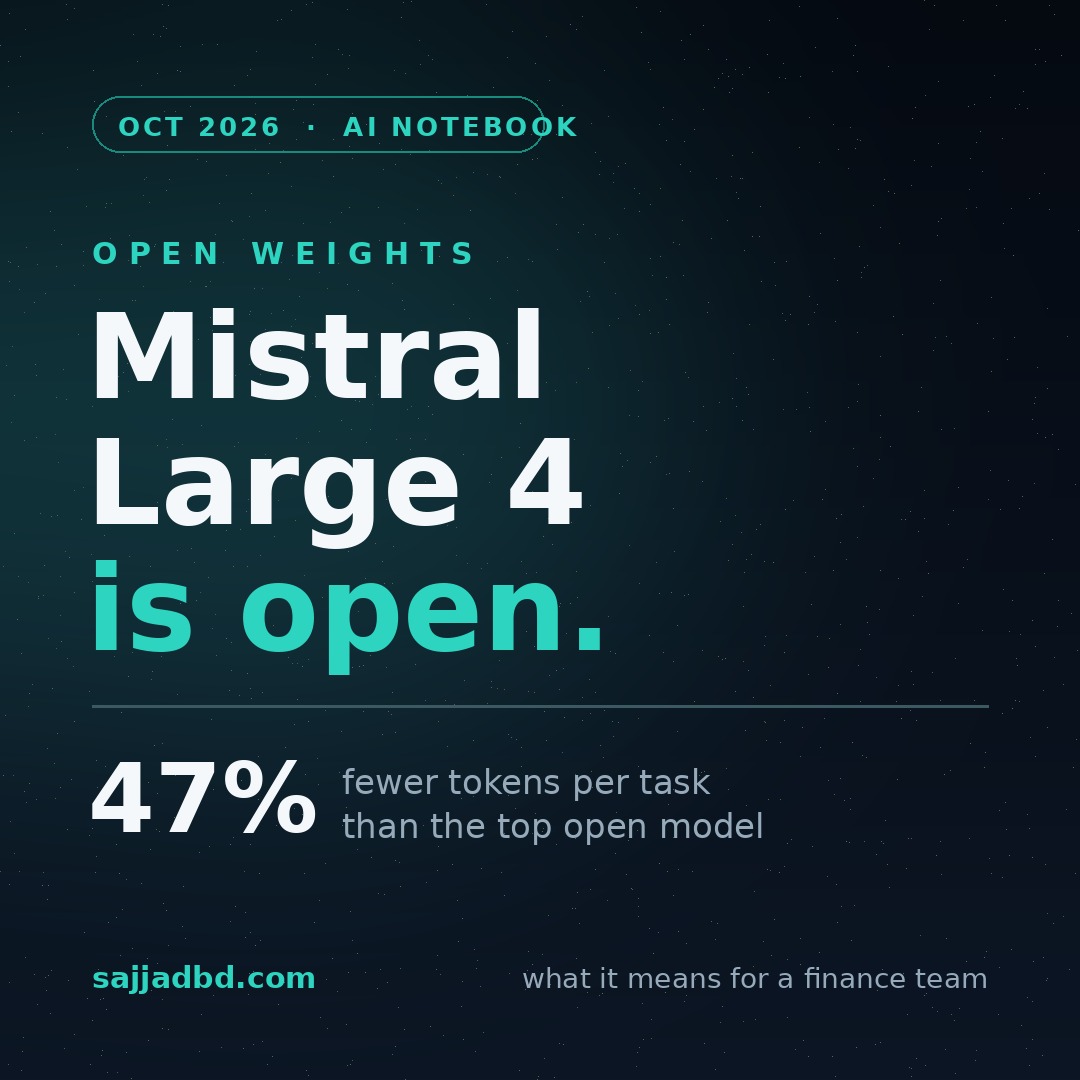
Another model release landed this week, and this one matters more than most to anyone who signs off on a company’s numbers. On 29 October 2026, Mistral released the weights of Mistral Large 4 — the model everyone is calling Le Chonk — a 1-trillion-parameter, natively multimodal model it had been previewing earlier in the month.
“Released the weights” is the phrase to notice. It means the model file itself is downloadable, not just a website you log into. I am a chief accountant, not a developer, so here is what I took from it, and what I am doing about it.
Why “open weights” is an accounting question, not a technical one
Three things I worry about with any software we depend on: the price can move, the terms can move, and the data goes somewhere I cannot see. A model whose weights are published answers the first two in a way a rented API cannot.
- Vendor risk. A tool you rent can be repriced or changed at renewal. A model you can hold can be run by someone else if your current provider becomes awkward.
- Data. Payroll, supplier statements, customer balances. If a model runs on hardware you control, that data does not leave the building. If it runs in someone’s cloud, it does — and you should know the terms before you paste a trial balance into it.
- Fallback. I have lost half a working day to a cloud outage before. An alternative host for the same model is a real, boring kind of insurance.
The numbers that caught my eye
Mistral says this is the best open-weight model for coding, and that the weights release comes after three more weeks of reinforcement learning on top of the preview. The figures it published: a 19.7% score on Cognition’s private FrontierCode 2.0 benchmark, and 48% on the Artificial Analysis Coding Agent Index — effectively tied with the leading open-weight model, GLM-5.3, while using 47% fewer tokens per task. It also offers three reasoning modes so you can trade depth for cost, and it was trained from scratch on European infrastructure.
The number that matters for a finance department is not the benchmark. It is the 47%. Fewer tokens per task means lower cost per task. Same job, less fuel. That is the line item I care about, the same way I care about a supplier who delivers the same goods with less wastage.
What it does not mean
A trillion parameters will not run on my office desktop, and it will not run on the factory server either. Self-hosting something this size needs serious GPUs, electricity, and somebody paid to keep it alive. For a mid-size company, that is a project, not a weekend.
Open weights also does not mean free. The licence is free; the bill is not. You pay in hardware, power, and staff time instead of a subscription.
And benchmarks are not my ledger. My test is always the same: my documents, my messy real data, my deadline.
What I am doing this month
- Not switching anything. What we pay for now works. Churn costs more time than it saves.
- Asking one boring question. Where does our data actually go when we use AI on client and supplier information? I want that answer in writing, not in a sales call.
- Re-testing my three standard tasks against whatever new model appears: reconciling a 400-line supplier statement, drafting a polite statement-of-account reminder, and writing a VBA macro to clean a trial balance. If a new model does those three better or cheaper, I will notice. If it only wins a leaderboard, I will not.
- Watching cost per task, not rankings. A model that is second-best but half the price is usually the right purchase for routine work.
The bigger picture
A year ago, frontier capability sat with a handful of labs and was priced accordingly. Now a trillion-parameter model is on the market with published weights and a European supply chain behind it. Prices fall when the buyer can walk away, and a buyer can walk away when there is somewhere to walk to.
For finance teams the practical effect is unglamorous and useful: cheaper month-end automation, more than one supplier to negotiate with, and a genuine reason to read the data terms instead of clicking accept.
None of this changes my job. I still check the numbers, because the model does not sign the accounts — I do. But a lower cost per task means I can push more of the boring work through it and spend the hours saved on the part that needs a human: deciding what the numbers actually mean.
Sources: Mistral’s release note, “Le Chonk: Built for Coders, Trusted by Defenders” (29 October 2026), and The Verge’s coverage of the release (29 October 2026).