Tencent Hy4 Can Now Read Charts for $0.83 per Million
I spend a large part of every month-end opening PDFs. Bank statements, supplier invoices, customs papers, a supplier’s statement of account that arrives as a photo because somebody printed, signed and scanned it. For years the honest answer to “can the AI read this?” was: sort of, if the page was clean.
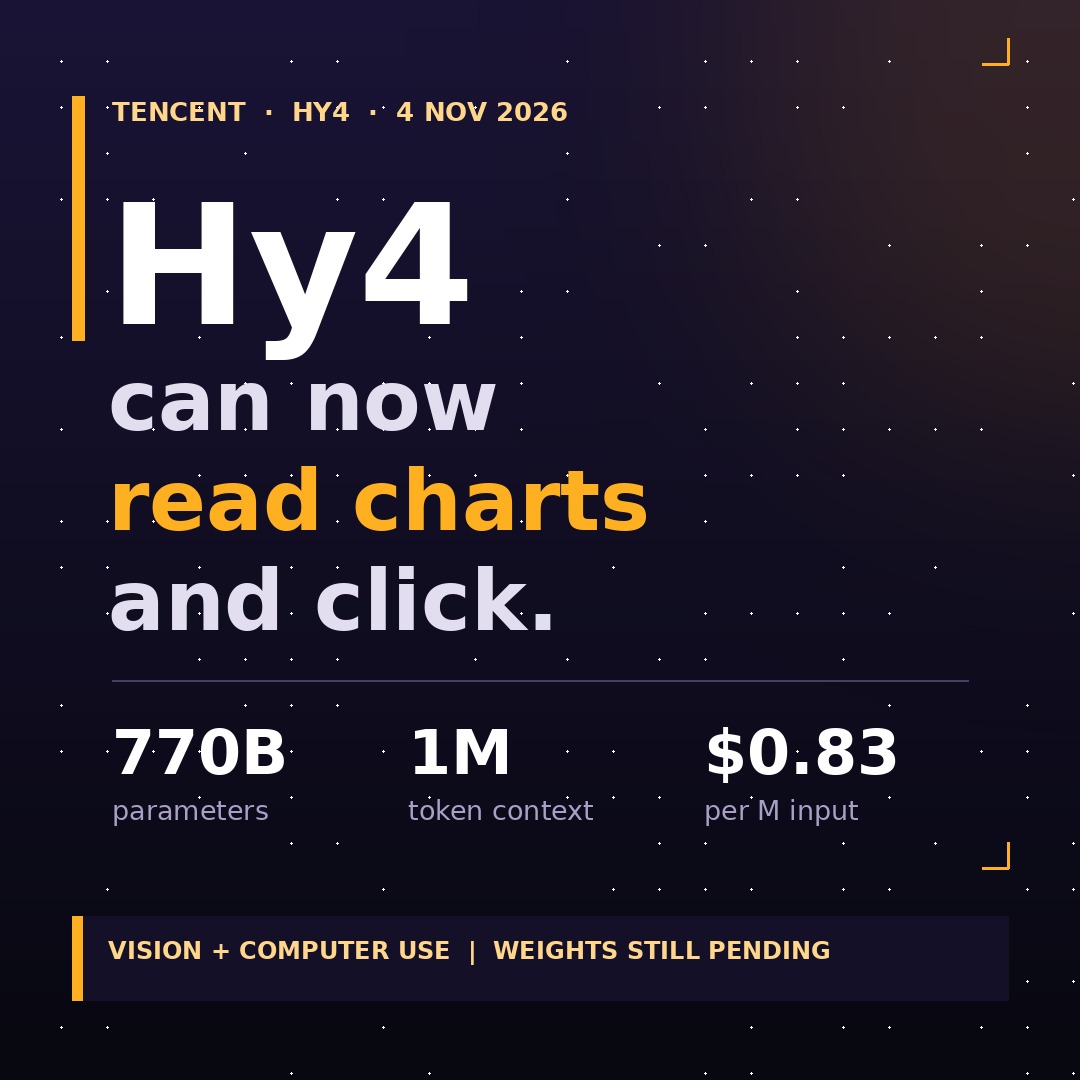
Yesterday Tencent shipped the full version of Hy4, and the part that matters to me is not the benchmark chart. It is that the model now takes images as input, reads charts and documents, and can click through software interfaces on its own. All of that at a token price that has not moved since the preview.
What actually changed on 4 November
Hy4 is a 770-billion-parameter model with a 1,048,576-token context window and a 65,536-token output limit. Text and images in, text out. The preview version from August could not see. This one can:
- Read fine-grained image detail, complex charts and multi-page documents
- Reason across several images in one request
- Operate command-line tools and graphical interfaces
- Work across Blender, CAD and multi-application workflows
Tencent also says it cut hallucinations in its internal search tests from 15.76% in the preview down to 5.45%, and speculative errors from 23.1% to 5.6%. That is the number I care about more than any leaderboard. A model that invents a figure in a financial statement is worse than no model at all.
The price, in numbers I can use
Standard API pricing is unchanged from the preview:
- $0.834 per million input tokens (about 0.314 BHD)
- $2.501 per million output tokens (about 0.940 BHD)
- $0.042 per million cached input tokens
- 50% discount on Tencent Cloud TokenHub until 31 December 2026
Put that against my own work. A 240-page supplier file, scanned and read in one pass, is roughly 300,000 input tokens. That costs about 0.094 BHD at list price, or under half of that with the current discount. The 1M context means I do not have to chop the file into twenty pieces and hope the model remembers page three.
It was tested on finance work, not just code
This is the detail that made me read the announcement twice. Tencent built thousands of simulated workspaces and tens of thousands of tasks, then had 213 finance professionals — 153 of them from financial institutions — evaluate the model on 579 real-world tasks. Hy4 scored 3.04 and ranked first among open-weight models, ahead of DeepSeek-V4.1-Flash at 2.97 and Kimi K3.1 Pro and GLM-5.3 at 2.68 each.
That is Tencent grading its own homework, so I treat the ranking as a signal, not proof. But the framing tells me where the work is going: office tasks, financial analysis and game development were the training focus.
The catch: “open” is coming later
Here is the part the headlines skip. The August preview was open-sourced. This full release is hosted only. The weights and a full system card are promised for a later date, with ecosystem support being built alongside vLLM and SGLang. A cheaper, faster Hy4 Flash is also planned.
So today you can use Hy4 through Tencent Cloud and OpenRouter, and inside CodeBuddy, WorkBuddy, Yuanbao and ima. You cannot download it and run it on your own server yet. If your company policy says client data never leaves the building, this release does not solve your problem — it just tells you the solution is nearby.
How I would actually use it
- Statement of account chasing. Drop the supplier’s PDF into one request and ask for invoice number, date, amount and days overdue as a table. Then check three lines by hand before you trust the rest.
- Chart reading. The one task small models fail at. Send a screenshot of an ageing report and ask which bucket moved.
- Bank reconciliation prep. Long context means the whole month of statement lines stays in view while it matches against your ledger extract.
- Never on final numbers. Use it to prepare, extract and cross-check. The person who signs the accounts is still the accountant.
Tencent also restricted cybersecurity training data on purpose — defensive proof-of-concept and patching only, with exploit development and reverse engineering filtered out. It is a company being explicit about what its model was and was not trained to do. I would like to see the same honesty in accounting benchmarks.
My verdict: Hy4 is the first cheap, long-context model I would trust to read a messy scanned ledger and hand me a draft. I will not trust it with the final figure. That combination — fast draft, human sign-off — is exactly where this technology earns its keep in a finance department.
Source: Tencent announcement and system documentation, 4 November 2026, via TechNode and Unite.AI coverage. Prices in USD; BHD converted at 0.376.