Gemini 4 Neon: Cheaper AI That Tops Accounting Tests
Google's Gemini 4 Neon costs $3 per million input tokens, reads a million-token workbook in one pass, and topped tax, legal and accounting benchmarks. What it means for month-end.
Google shipped a new model on Wednesday, 18 November: Gemini 4 Neon. My first instinct was to ignore it. Google has pushed out four Gemini models in a month, and most of them did not change how I close a month. This one caught my attention for two unglamorous reasons: the price per token, and a benchmark list where accounting finally shows up by name.
What Neon actually is
Neon sits below Carbon and Argon in Google’s line-up. It is not the smartest model they make. On the Artificial Analysis Intelligence Index it scores 61, third overall, behind the larger and slower models.
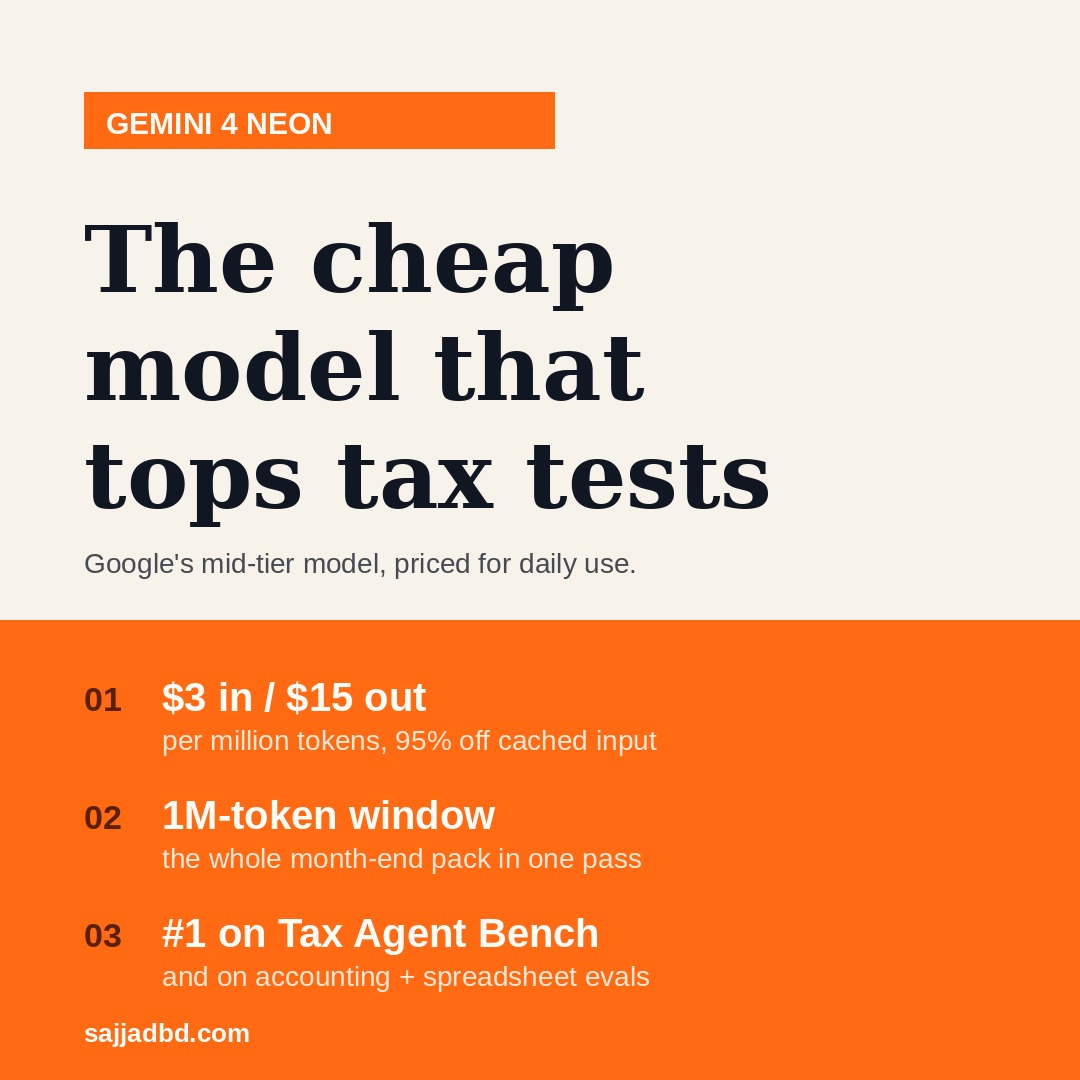
Google’s own numbers put Neon at #1 on the Tax Agent Bench and #1 on the Legal Research Bench, and at #2 on the Vals Index with 70.9%. On the Surge AI evaluations it ranks first on most benchmarks across finance, accounting, spreadsheet modelling and complex constraint following. It also scores 73.5% on Chartography, a test of reading dense professional charts.
I have been burned by benchmark claims before, so I treat all of that as a strong hint rather than a promise. But a model that wins on tax and spreadsheet tasks is closer to my desk than one that wins on competitive programming.
The price is the real headline
Neon is priced at $3 per million input tokens and $15 per million output tokens, with cached input at $0.15 per million — a 95% discount. The context window is one million tokens.
Put that in Bahrain terms. A month-end review pass where I feed a 60,000-token extract of a trial balance plus supporting notes, and get back 8,000 tokens of commentary:
- Input: 0.060 million × $3.00 = $0.180
- Output: 0.008 million × $15.00 = $0.120
- Total per pass: $0.300, about 0.113 BHD at 1 BHD = 2.6596 USD
If half of that input is the cached, unchanged part of the workbook — the chart of accounts, the mapping table, the standing instructions — the cached slice drops to $0.15 per million:
- Cached input: 0.050 million × $0.15 = $0.0075
- Fresh input: 0.010 million × $3.00 = $0.030
- Output: 0.008 million × $15.00 = $0.120
- Total per pass: $0.158, about 0.059 BHD
Fifty-nine fils for a full review pass. That is not a budget line. That is rounding.
Google also says Neon comes in about 32% cheaper per task than Gemini 4 Carbon at its default thinking level, and 36% or more cheaper than competing frontier models at their highest setting. Four thinking levels let you dial the spend per job: quick classification at low, a full reconciliation narrative at high or xhigh.
Why the one-million context matters to me
Most of my AI frustration is not intelligence, it is plumbing. I split a workbook into twenty chunks, get twenty inconsistent answers, then spend an hour stitching them. A single million-token window means I can hand over the whole monthly pack — the GL extract, the aged receivables, the bank reconciliations, the variance notes — and ask one question instead of twenty.
Neon also does something I did not expect from a mid-tier model: in Google’s Antigravity demo, an agent built a 100,000-cell Google Sheet from a single image, using over 500,000 live formulas with no Apps Script and no embedded pictures, to run edge detection and depth mapping. That is a parlour trick for a spreadsheet. It is also evidence the model understands formulas as structure, not as text.
Where to try it, and how I would use it
Neon is rolling out in the Gemini API and Google AI Studio, in Gemini for business, in Google Antigravity for paid AI Pro and Ultra subscribers, and in the Gemini app for Pro and Ultra. The API and AI Studio routes are the ones that matter if you want it inside your own workbook checks; the app is the easiest place to form a first opinion.
My plan is narrow. I will not let it near a journal entry. I will use it for three things: reading a supplier statement against my ledger and listing the differences, turning a dense variance table into a first-draft commentary, and checking a tax treatment against the source documents I paste in. Every output gets checked against the ledger, because the model reads, it does not post.
The pattern across the last month of releases is clear. The expensive frontier models are for the hardest reasoning. The mid-tier models — Neon, Fable 5.2, the cheaper Astra tier — are where the daily accounting work will actually live, because the cost per task finally stops being the constraint. The constraint becomes my review time.
That is a better problem to have.