GPT-6.2 Astra: Spreadsheets That Follow Your Template
OpenAI's GPT-6.2 Astra and Sol keep my Excel templates and cut token costs 20%. A chief accountant's plain test plan for month-end work.
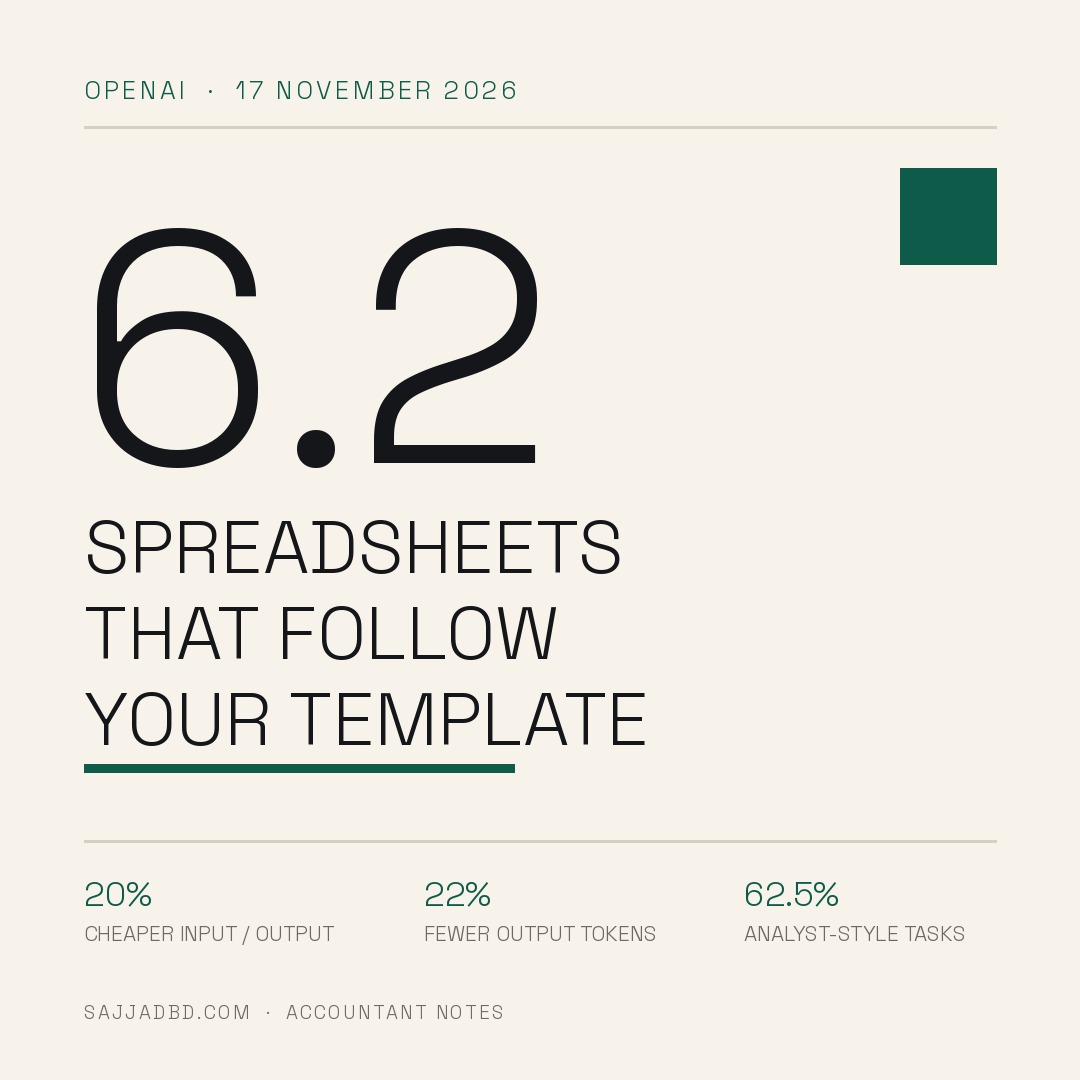
OpenAI released two new models on Tuesday 17 November 2026: GPT-6.2 Astra, which it calls its frontier model for the hardest projects, and GPT-6.2 Sol, the cheaper everyday model. I read the announcement on OpenAI’s own site rather than a second-hand summary, because the wording matters when I have to decide whether to change how my team works.
I am not a developer. I close books. So I skipped the coding benchmarks and looked for the one sentence that changes my week: the models were trained to produce slides, spreadsheets and documents that “more closely follow the conventions professionals use in fields like law, sales, finance, and accounting.” That is the first time I have seen accounting named in an OpenAI launch note.
What that actually means at my desk
Most AI spreadsheet help fails the same way. You ask for a working file and get something tidy-looking that ignores your layout — headings in the wrong row, the currency column formatted as text, the variance column missing. You then spend twenty minutes repairing it, which is longer than doing it yourself.
OpenAI says Astra follows a template you supply, including from a screenshot, matching layout, colours and typography down to the font size. If that holds up on my own month-end pack it saves real time; if not, I have lost ten minutes. Cheap bet.
The numbers worth knowing
- Price: in the API, Astra costs $8 per million input tokens, $0.40 per million cached input tokens, and $40 per million output tokens — 20% lower than GPT-6 Astra.
- Sol: keeps the same API prices as GPT-6.1 Sol, so everyday drafting does not cost more than before.
- Fewer tokens: OpenAI reports Astra used 22% fewer output tokens than GPT-6 Astra on its GDPval v2 work-sample benchmark while scoring 6.2 points higher.
- Analyst-style tasks: on Artificial Analysis’s AA-AnalystAgent test — building numbers out of real spreadsheets and reports — Astra answered 62.5% of questions correctly on all five attempts, a new high.
- Cyber: both models meet OpenAI’s Critical threshold for cybersecurity, so expect tighter refusals on security-type requests. Not my problem, but it explains odd refusals if you ask for anything that looks like a hack.
Cost in Bahrain terms: a month-end pack of twelve files, roughly 60,000 tokens in and 8,000 out, costs about $0.80 at Astra’s API rates (60,000 × $8 per million = $0.48, plus 8,000 × $40 per million = $0.32) — about 0.301 BHD per full review pass. Cost is no longer the worry; accuracy is.
My test plan for this week
I do not switch tools on a launch post. I run three checks, in this order.
One: my own template. I upload last month’s closing workbook, blank the figures, and ask for a rebuild using the same layout. I check column widths, number formats, frozen panes, and whether the totals row still uses a SUM formula rather than a hardcoded number. A hardcoded total is the failure that gets past review.
Two: a tie-out. I feed it a trial balance and an aged receivables report and ask it to prove the two agree. Any model can produce a schedule. The useful question is whether it notices when the schedule does not balance. I want it to say “these do not tie, here is the 1,250.000 BHD difference” rather than quietly plug the gap.
Three: the boring one. I ask for a short memo to my GM on the receivables position and count how many sentences I have to delete. Fewer than three and it is worth the subscription.
Which model I would pick
Sol, for almost everything. For rewriting a collection email, explaining a formula, summarising a supplier contract, it is enough. Astra earns its price on the two or three jobs a month where I need a long document read end to end and a proper deliverable out: a board pack, a policy review, a reconciliation of a messy ledger extract. That is where the template-following and lower token burn matter.
The caution I keep repeating
Benchmarks measure a model against someone else’s tasks. They do not know my fixed asset register has a quirk in the depreciation line, or that one supplier’s statement arrives in a different layout every quarter. The model is a fast junior who has read everything and has never met our auditor.
So the rule stays: AI drafts, I sign. Nothing reaches the ledger until a human has tied the total to the source document. Better templates speed up the drafting; they do not move the signature.
If you run a finance team in Bahrain, write down your test before you open the tool. Deciding what “correct” looks like after the model answers is how people end up trusting a number they never checked.