Inkling 2 Mini: AI That Runs on Your Laptop
Thinking Machines' Inkling 2 Mini is an open AI model that runs offline on a 32 GB laptop — what it means for payroll, client data and your AI bill.
Every time I paste a salary sheet into a chat window, I pause for a second. Not because the model gets the numbers wrong. Because I have just sent a payroll file to somebody else’s server, and I cannot tell my auditor where it went.
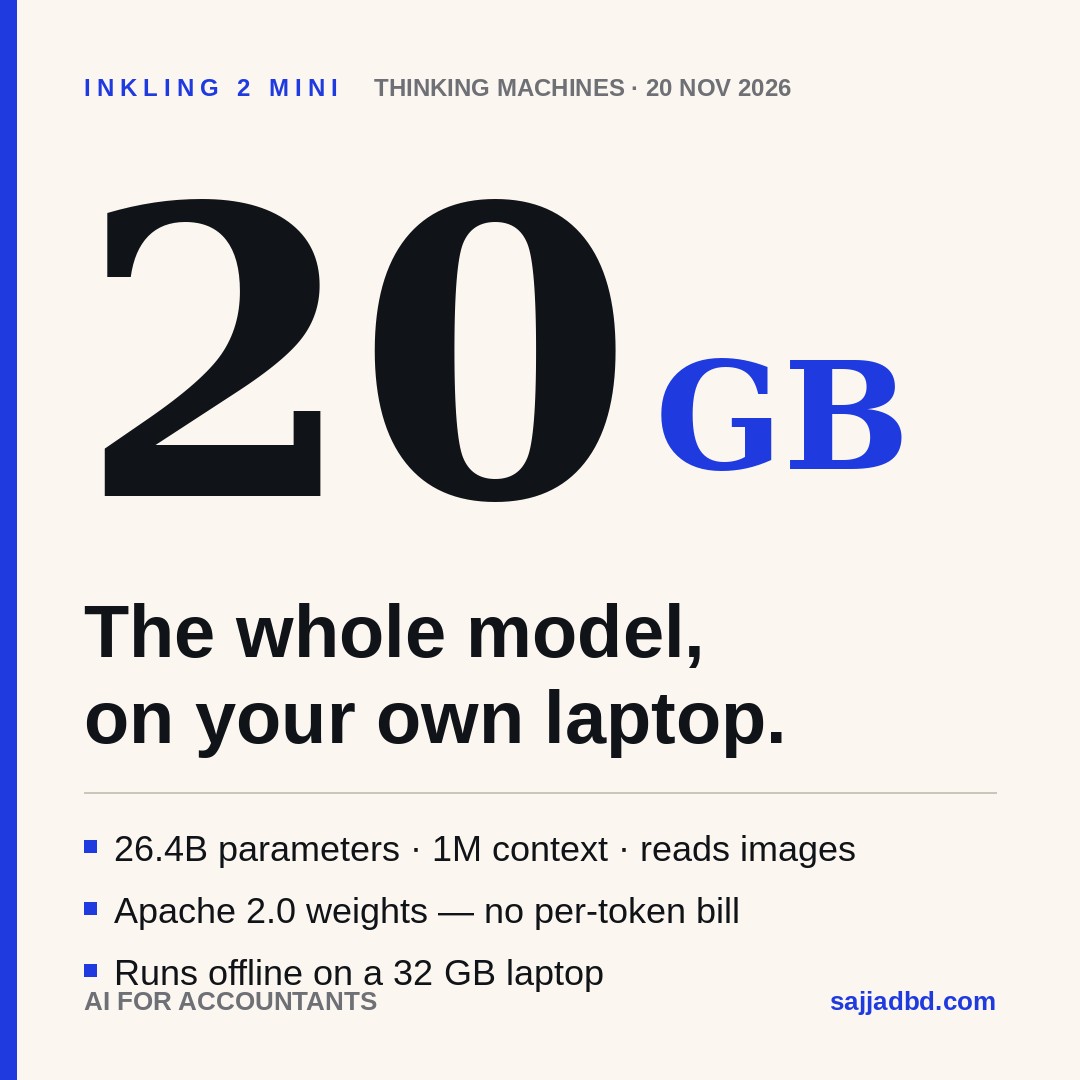
That pause may be getting shorter. On Friday 20 November 2026, Thinking Machines Lab — the company led by Mira Murati, the former chief technology officer of OpenAI — released a model called Inkling 2 Mini. It is open weights, Apache 2.0 licensed, and it runs on a laptop. About 20 GB of memory. No internet connection required.
This one is different, for a boring reason that matters to accountants: the data never leaves the machine.
What was actually released
Inkling 2 Mini is a 26.4 billion parameter mixture-of-experts model. On a normal pass it activates 3.4 billion parameters and routes each token to 8 of its 128 experts. The clever part is the architecture. Of its 24 layers, the first six and the last six run once, while the middle twelve run three times using the same weights. That gives 48 effective layer applications per token, and about 5.4 billion effective active parameters, without making the file bigger.
In plain terms: instead of writing three pages of workings, the model re-checks its own arithmetic three times before answering. Thinking Machines says a non-looping model of the same size needed 140% more compute to reach the same quality.
The practical specs are what caught my attention:
- Roughly 20 GB footprint, running offline on a 32 GB MacBook Pro or a single desktop GPU
- 1 million token context window, and it reads images as well as text
- Apache 2.0 licence — download it, use it commercially, no royalty, no per-token bill
- Available on Hugging Face, plus Ollama, LM Studio and other local runtimes
The numbers, without the hype
Artificial Analysis gives it 20.1 on its Intelligence Index. That ties Alibaba’s Qwen3.8-27B, a dense model that needs far more hardware to serve. The same evaluation reports Inkling 2 Mini runs about four times faster per task (9.0 minutes against 38.2) and costs roughly six times less ($0.59 against $3.53 at first-party API prices).
On coding and tool use it leads every open model under 100 billion parameters: 48.2% on DeepSWE v1.1, 79.2% on SWE-bench Verified, 85.3% on DeepSearchQA. If you have asked an AI to clean a messy Excel export with a Python script, that is the score that matters.
A worked cost example, in our money. Hosted, it charges $0.15 per million input tokens and $0.50 per million output tokens. One million tokens in and 200,000 out comes to $0.15 + $0.10 = $0.25, which is about 0.094 BHD. Run it on your own laptop and that per-token cost disappears entirely; you pay for electricity and the hardware you already own.
Where it is weak — and this part matters more
An honest post has to say what it cannot do. Factual recall scales with total size, and this model is deliberately small. On AA-Omniscience it scores -8.6 with a 63.4% non-hallucination rate, behind Qwen3.8-27B at -6.4 and 71.4%. It trails on multi-turn chat (50.0% on MultiChallenge) and on instructions with several constraints at once (33.4%). Early testers also report occasional repetitive debugging loops and clipped phrasing outside English.
So I would not let it finalise a VAT return or answer “what is the current rate” from memory. A small model that loops its own thinking is a careful drafter, not a reference book.
How I would use it this month
- Drafting payment reminder letters from an ageing list, with customer names kept on my own disk
- Reading scanned supplier invoices and pulling out date, number, amount and VAT, using the image input
- Writing and fixing the small Python scripts I use to clean ledger exports
- Anything that touches a salary column, a passport copy or a client’s bank details
And what stays in the cloud: month-end review where I need current rules and reliable facts, management presentations, and any question where being wrong politely is worse than being slow.
Bottom line
The headline is not the benchmark score. It is that the price of privacy has fallen to the price of a laptop. Two years ago “AI that stays on your machine” meant a toy model that could not follow instructions. This one ties a 27 billion parameter flagship in 20 GB, for free, with the plug pulled out.
If you have a 32 GB machine and a folder of files you would rather not upload, this is the week to try it. Start with one task you already know the answer to, check the output line by line, and keep the cloud model for the work that needs facts.