GLM-5.4: Deeper Thinking Without a Bigger Model
Z.ai's GLM-5.4 loops 28 layers twice instead of growing to 2 trillion parameters. What the 750B Loop Transformer means for month-end work, cost and code.
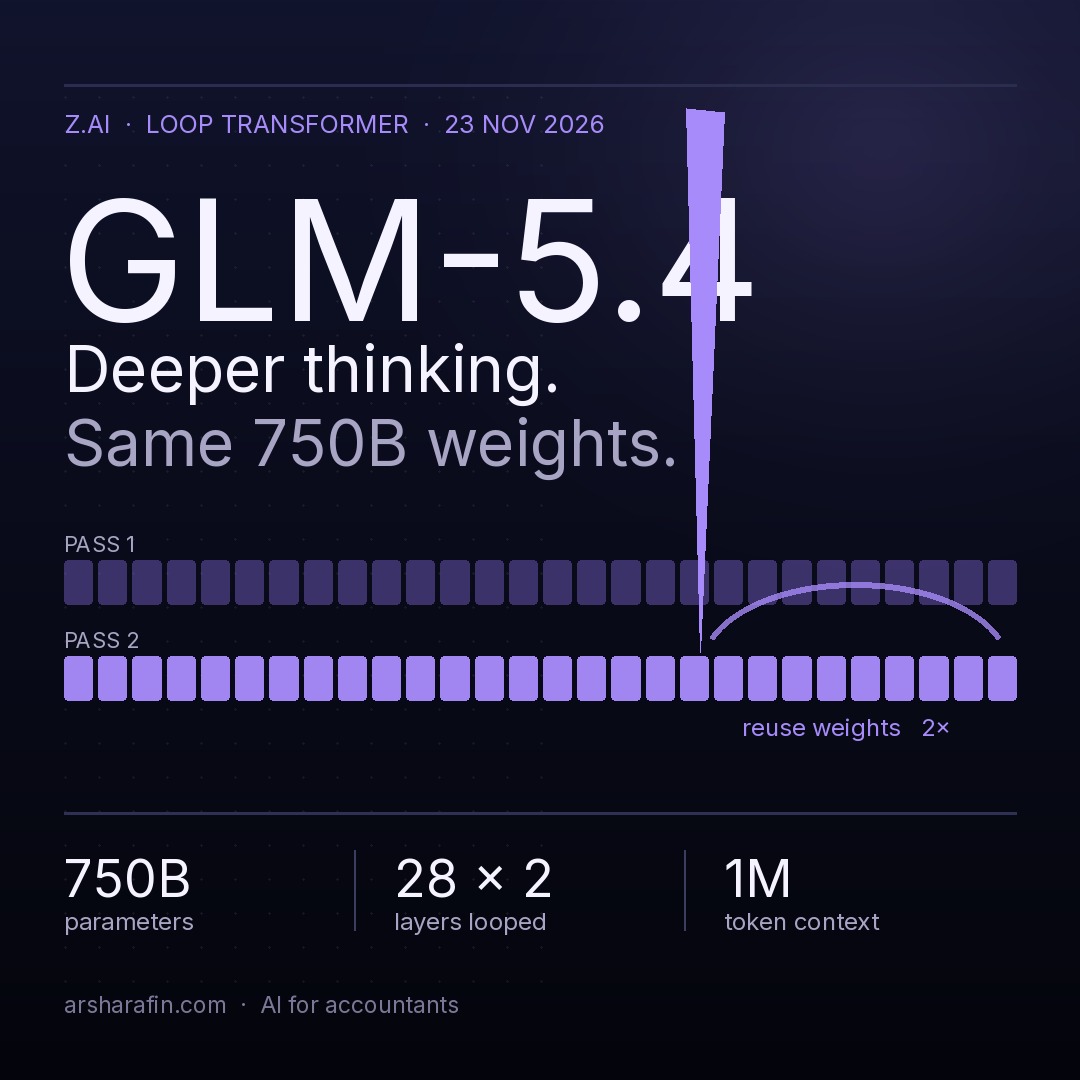
Most new AI models get better by getting bigger. Z.ai’s GLM-5.4, released today (23 November 2026), tries something different: it runs the same 28 layers twice instead of adding more of them. I have been testing AI on ledgers and month-end work for months now, so let me explain what this actually means in plain terms — and what it does not mean yet.
What Z.ai actually shipped
GLM-5.4 is a 750-billion-parameter model, and it is the company’s first flagship built on what it calls a Loop Transformer. In a normal model, each layer gets one pass through the data. In GLM-5.4, 28 layers from the GLM-5 base model are run for two iterations with shared weights. The network gets deeper reasoning without a single new parameter being added.
Z.ai says this puts it in the same intelligence range as models with 2 to 3 trillion parameters — roughly three times its size. They tested the idea first on smaller 1B, 4B and 30B models before committing the flagship to it, which is the sensible order to do this in.
Three engineering choices keep the cost from running away: per-token gates decide how much each pass writes back, a hybrid cache means the second loop needs one sliding window instead of a full context cache, and the second pass reuses the attention indices from the first. The practical claim is that the extra loop barely moves deployment cost at long context — up to one million tokens.
Why an accountant should care
My work is not writing software. It is reconciling a supplier statement, chasing a BD 40 difference across 900 rows, and explaining to a manager why the VAT figure moved. That kind of work needs a model to hold a long chain of reasoning without dropping a step halfway.
Two details from this release matter more to me than benchmark scores:
- Shorter output. In their tests, looping cut average answer length by 10–14%, mainly by shortening the visible chain of thought. Less scrolling, less noise.
- Vision on the coding plan. GLM-5.4 adds image input. A scanned invoice or a photographed bank statement is exactly the kind of thing I feed these tools, and it is now in the standard plan rather than a separate product.
They also raised the weekly quota by 50% compared with GLM-5.3 for users on the GLM Coding Plan. If you are paying per month, that is the most concrete number in the announcement.
What I would not believe yet
No benchmark scores for GLM-5.4 have been published. Z.ai says they will come later. The demos are impressive — a six-axis robotic arm designed in FreeCAD, a playable game with physics and art, an interactive 3D scene built from pure shaders — but a demo is a demo. Whoever picks the demo also picks the task.
The company also admits the obvious weakness: the model gets caught in very long “marathon thinking” loops. They argue the extra self-correction still improves accuracy. Maybe. From an accounting view, a tool that thinks for four minutes to tell me a number I could have checked in thirty seconds is not a saving. I will believe the efficiency claim when I see it on a real trial balance, not on a leaderboard.
Availability and what I am doing about it
GLM-5.4 is live now in Z.ai Chat, the GLM Coding Plan and ZCode. The API is listed as coming soon, after a safety evaluation, and the open weights will follow once safety hardening is done. So there is no price per million tokens to compare yet, and no local install for anyone watching their data.
That is the honest position: it is available to subscribers, it is not yet available to build on.
My plan is simple. When the API opens, I will run two tests before trusting it with anything real: a 500-row bank reconciliation with three deliberate mismatches planted in it, and a supplier statement where the opening balance does not agree. A model that finds all three and explains them in plain language is useful. One that writes a confident paragraph while missing a row is worse than useless, because it costs me the time to check it anyway.
For now, the interesting part is the idea itself. If you can get deeper reasoning by reusing layers instead of buying more GPUs, then the price of good AI accounting help keeps falling — and that is the trend I have been betting on all year.