Sakana Namazu Small: 30B AI That Reads Your Documents
Sakana AI's 30B Namazu Small reads long documents and cites its sources - why that matters for month-end, VAT queries and audit files, and where it still fails.
Most of my week as an accountant is not arithmetic. It is reading. A supplier statement arrives as a PDF. A VAT query asks me to point at the exact invoice line. An auditor wants the clause in the contract that allowed the discount. The adding up takes minutes. Finding the sentence that proves it takes hours.
That is why this week’s release from Sakana AI got my attention more than another headline about a trillion-parameter model. On 25 November 2026, the Tokyo lab announced Sakana Namazu Small, a 30-billion-parameter model trained to do exactly that job: read long documents, search the web, and answer with the evidence showing.
What it actually is
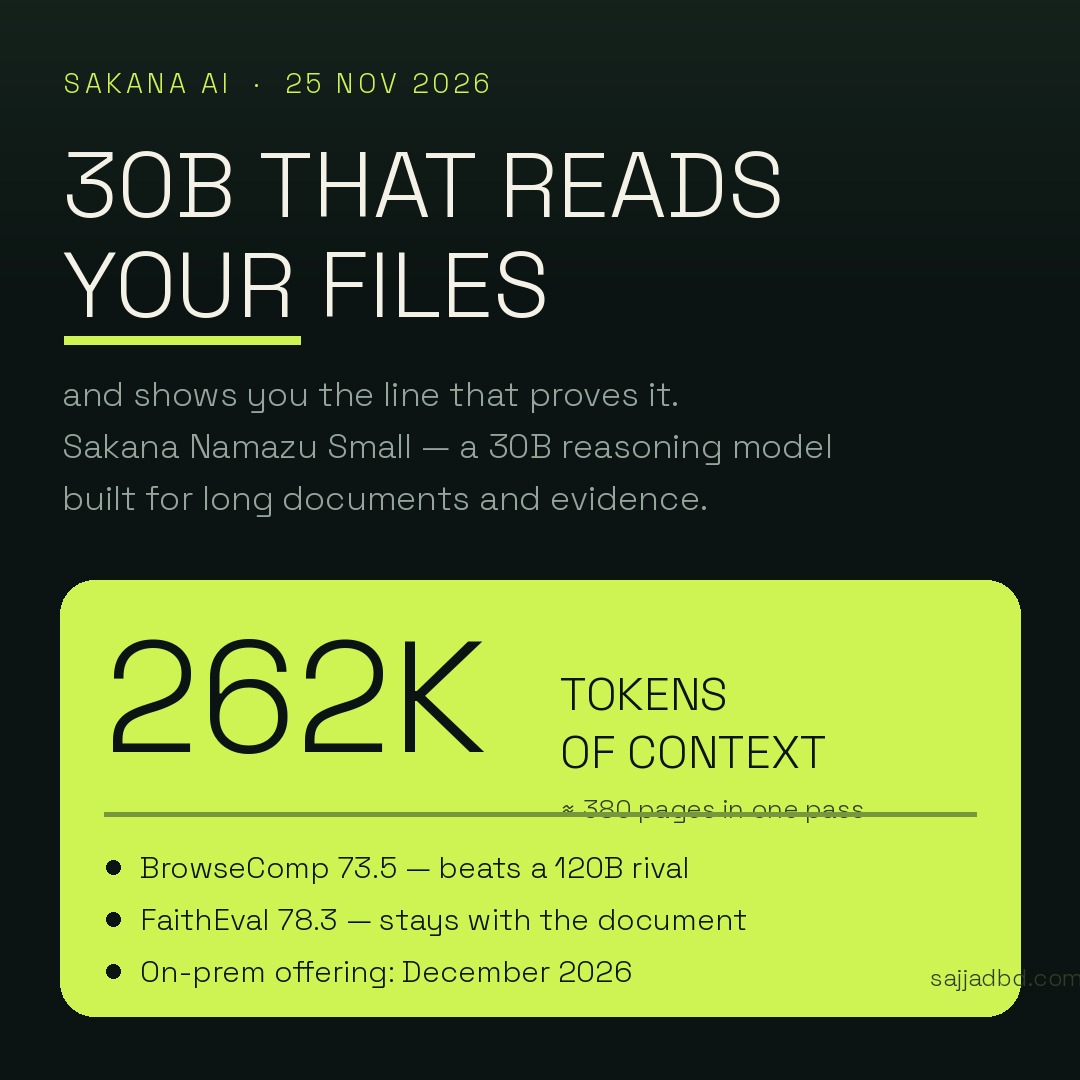
Sakana did not build the model from zero. It started from NVIDIA’s open Nemotron 3 Nano base and did its own continued pretraining and post-training on top. The result is a reasoning model that runs at 262,144 tokens of context and up to 32,768 tokens of output — enough for a full set of management accounts in one pass.
Roughly, 262,000 tokens is about 190,000 words, or a 380-page report. That is not a demo number. That is a year of board packs, a full contract file, or twelve months of bank statements in one prompt.
The numbers that matter
Sakana tested it on 25 benchmarks against NVIDIA’s own post-trained Nemotron 3 Nano (same size) and Nemotron 3 Super (120B, about four times larger). On the average score it beat both. The gaps are biggest exactly where my work lives:
- BrowseComp: 73.5 vs 29.3 (Nano) and 36.1 (Super) — multi-step web research.
- DeepSearchQA: 84.3 vs 70.7 and 65.4 — digging until the answer surfaces.
- LongBench-Cite: 80.2 vs 67.4 and 68.3 — long documents with citations.
- FaithEval: 78.3 vs 51.2 and 59.1 — staying faithful to the document it was given.
- LLM-jp LongBench: 86.0 vs 67.0 and 60.0 — long Japanese documents.
Read that FaithEval line again. A model that scores 51 percent on faithfulness is one that will quietly invent a number when the page is unclear. At 78 percent it is still wrong sometimes, but it is wrong far less often — and it is the closest thing to an audit trail a small model has offered so far.
Where it is weak — and this matters
Sakana says it plainly: knowledge did not improve. On internal-knowledge questions the model is poor. SimpleQA Verified: 6.8, against 9.1 and 18.1 for the Nemotron models. Japanese SimpleQA: 8.0 against 24.9. HealthBench: 40.6, below both.
For me that is not a defect, it is an instruction. Use this model as a reader, not as an authority. Give it the file and ask what the file says. Never ask it what the VAT rate is from memory. If I follow that one rule, the weakness costs me nothing and the strength does all the work.
What I would use it for on Monday
- Supplier statement reconciliation. Load the statement and the ledger export, ask which invoices are missing and get page references back.
- Audit queries. One folder of contracts in, one answer with the clause quoted out.
- VAT and NBR correspondence. Long letters, many references — ask for the deadline and the amount disputed, with the source sentence.
- Closing checklists. Feed the prior-year working papers and ask what is still unposted this month.
The part that decides it for a finance team
Sakana says on-premises availability details will come in early-to-mid December 2026, and that 30 billion parameters is a size a company can realistically run on its own hardware. For a finance department that cannot send ledgers to a public cloud, that is the sentence that matters more than any benchmark.
The work was supported by GENIAC, Japan’s METI and NEDO programme for domestic generative AI. Note what is not in the announcement: open weights. There is a model, a benchmark table, and a promise of an on-prem offering. No download link, no price. Anyone planning around this should wait for December.
My honest verdict
Not a replacement for a careful accountant. A very good first reader. The pattern that works is the one I already use with people: hand over the document, ask a narrow question, demand the source. Namazu Small is built to answer that way, which makes it more useful to me than a bigger model that answers confidently from memory and cannot show me the line.
I will test it against one real month-end file when the on-prem details land. If it can cut the document hunt from three hours to thirty minutes, the arithmetic takes care of itself.