Claude Personal Finance: An Accountant’s First Look
Claude can now read your bank and card accounts via Plaid. An accountant reviews what Anthropic's Personal Finance tool does, what it will not do, and where to be careful.
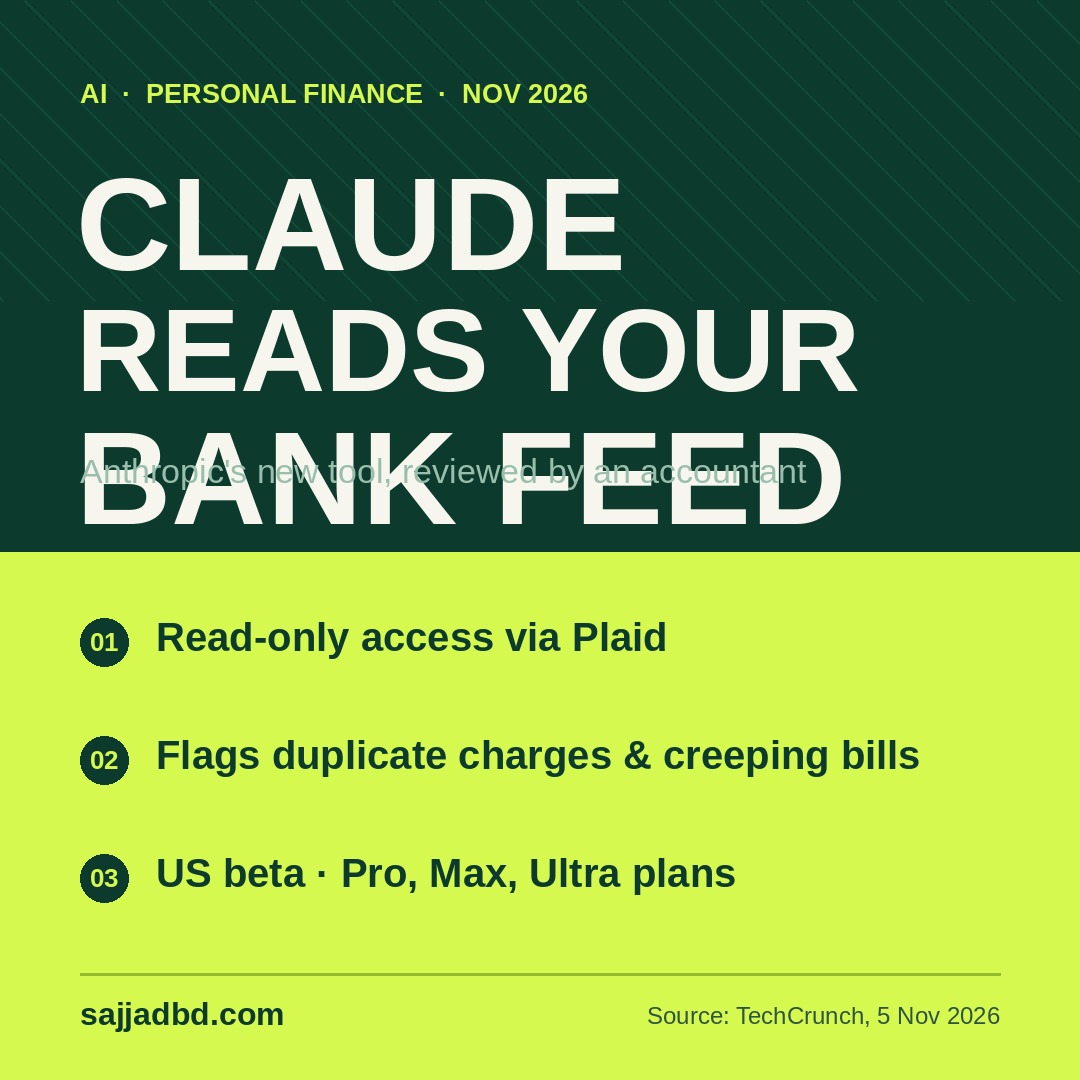
On Thursday, 5 November 2026, Anthropic announced that Claude can now connect to your bank and credit card accounts. The feature is called Personal Finance. My first reaction as a chief accountant was not excitement — it was “show me the controls”.
I have spent twenty-plus years reconciling statements, chasing duplicate charges, and explaining to people where their salary actually went. So when a chatbot says it can do that for me, I read the fine print twice. Here is what the announcement actually says, and what I think it means for anyone who keeps books for a living.
What Anthropic actually shipped
The facts, as reported by TechCrunch on 5 November 2026:
- Claude connects to bank and card accounts through Plaid, the same plumbing most budgeting apps use.
- Access is read-only. Claude cannot move, manage, or invest your money.
- Anthropic limits what it can see: bank name, account name and type, the last four digits of the account number, balances, credit limits, and up to two years of transaction history.
- Conversations inside the Personal Finance hub are not used to train the models.
- It starts as a beta this week, for Pro, Max, and Ultra subscribers in the US only.
- ChatGPT already launched a similar tool in May 2026. Claude is catching up, not leading.
Nothing there is magic. But two of those lines are the ones I care about: read-only, and no training on your data. Without both, I would not let it near a bank feed.
What it does that I already do by hand
Three things, and they are the three most tedious parts of a personal spending review.
1. “Where did my money go this month?” You ask it in plain language. It totals spending across connected accounts and sorts it into categories — rent, utilities, food, shopping. Then you can push further: “Is that more than usual?” That follow-up question is where most dashboards stop and where a real conversation starts.
2. Flagging the small leaks. Anthropic says it looks for duplicate charges, unexpected fees, and bills that keep creeping upward. This is exactly the work I do when a client says their card bill feels wrong. A duplicate subscription at BHD 4.500 a month is BHD 54.000 a year — and almost nobody notices it.
3. Explaining the jargon. It can explain APR and calculate how much interest you actually paid over the past year. I do this for family members constantly.
What it will not do
This is the part I would underline in red.
- It is not bookkeeping. No double entry, no ledger, no trial balance, no audit trail. It reads transactions; it does not post them.
- It is not a reconciliation. Matching a bank statement to a cash book line by line, with dates and reference numbers, is still your job — or mine.
- No business accounts, no VAT, no accruals. My world runs on BHD with three decimals, supplier statements, and month-end cut-offs. A consumer spending summary does not touch that.
- US only, for now. If you bank in Bahrain, this beta is not open to you yet.
- It gives answers, not assurance. No working papers, no sign-off, nothing you could hand to an auditor.
The part that matters for accountants
I keep hearing that AI will replace bookkeepers. Reading this launch, I see the opposite: it automates the question-asking layer, not the recording layer.
A client can now ask “am I spending more than I earn?” and get a straight answer without opening a spreadsheet. That is genuinely useful. But the moment the question becomes “is this expense capital or revenue?”, or “why is the supplier ledger out by BHD 127.350?”, the tool has nothing to stand on. It has no concept of accrual, materiality, or documentation.
What it does change is the first pass. Instead of building the summary myself, I can start from a summary and spend my time on the exceptions. In accounting, the exceptions are where the money and the risk live.
What I would tell a colleague
Use it as a reviewer, not a recorder. Ask it questions you would ask a sharp junior who has read every transaction but has never closed a month. Trust the totals enough to investigate them; do not trust them enough to file anything.
And read the access permissions before you connect a single account. Read-only, two years of history, no model training — those three lines are the whole ballgame. If any one of them disappeared in a future update, I would disconnect the same day.
The tool is a good first step. The discipline is still ours.
Source: TechCrunch, “Claude can now analyze your spending with its new Personal Finance tool”, 5 November 2026.